Makeshift Cat Carrier: 6 Emergency Options That Actually Hold a Cat

By the PetzyMart Team · Sources linked in the text · Last updated: September 8, 2026
The cat is limping. Or bleeding. Or the evacuation order just came through. And the carrier is in a storage unit across town. You need something in the next five minutes.
A makeshift cat carrier has to do three things. It must hold the cat in. It must let air in. And it must stay closed. A laundry basket with a lid does all three. So does a taped cardboard box with air holes. A loose cat in a car does none of them. Every option below exists to prevent that one outcome.
Six emergency cat carrier options follow, ranked. Each takes under five minutes. Each comes with the moment it fails.
The Three-Part Test
Run any object in the house through this first:
✅ The three-part test. Check each one:
- Contain: she can stand and turn, but cannot jump or squeeze out
- Ventilate: air moves through several openings, on more than one side
- Stay closed: she pushes and shoulders the lid, and it does not lift
The third line matters most in the car. The AAFP position statement on transporting cats in motor vehicles is plain. Cats should travel inside a suitable carrier, secured in the vehicle. A cat loose in the cabin endangers the cat and the driver. An emergency cat carrier that opens at the first bump is a loose cat with extra steps.
Not your first scramble? The stress-free cat transport training plan is how you make it the last one.
Six Options Ranked
Options 1 and 5 are for your arms and the walk in. Options 2, 3, and 4 are for the drive. Option 6 can replace all of them.
1. Pillowcase
For getting a cat out from under the bed, into your arms, and across a clinic waiting room. Not for the car.
Build: one thick cotton pillowcase, shaken open.
Load:
-
1
Come from behind
Do not let her see the pillowcase first.
-
2
Slide the open end over her head and body
One smooth motion, head first.
-
3
Gather the opening at your chest
Hold it closed in your fist. Do not tie a knot.
Why: a knot cuts the air. A fist opens in a second.
Head out is fine for a calm cat. Fully in is better for a cat that is already fighting.
Fails when: it is set down on a car seat. A pillowcase is a handling tool, not a container. A cat can shred thin cotton in under a minute. Is she crying or thrashing inside? Our notes on how to comfort a cat in a carrier in an emergency work just as well for a pillowcase.
2. Laundry Basket
The best container most homes already own. It is plastic. It has air holes on every side. It is light enough to belt into a seat.
🧺🧺 You have two baskets
Set them mouth to mouth. Tie the four corners with shoelaces or zip ties.
🧺 You have one basket
Lay a bath towel over the top. Pin it down on all four sides with zip ties, binder clips, or a belt cinched around the rim.
Load: towel on the floor of the basket. Lower the cat in from above. Lid on and tied before you let go.
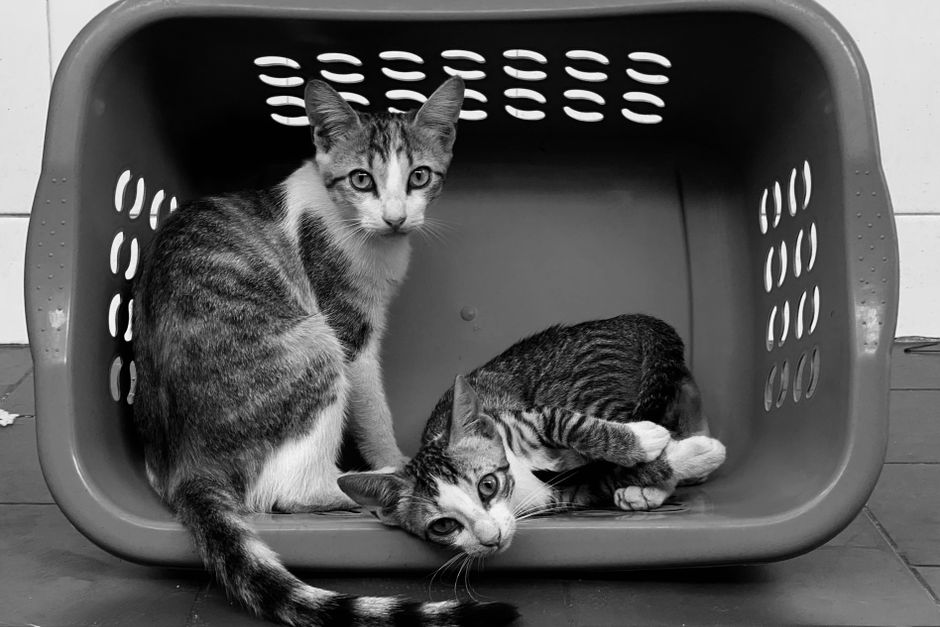
In the car, it goes on the back seat. Thread the seat belt through the handles and click it in. The AVMA advises keeping any carrier secured and as close to the centre of the vehicle as you can.
Fails when: the towel is draped, not pinned. When the holes are wide enough for a paw. And when a corner of the lid can lift an inch.
3. Cardboard Box
For the house with no baskets. Safe for exactly one dry trip.
-
1
Pick the box
One she can turn around in. No bigger.
-
2
Punch the air holes
Six to eight coin-sized holes per side. Before the cat goes in.
-
3
Towel on the bottom
Grip, plus it soaks up a small accident.
-
4
Cat in, flaps down
Lower her in from above. Close the flaps at once.
-
5
Tape every seam
Packing tape where the flaps meet.
-
6
Wrap the box
Two full wraps in each direction.
Fails when: the cat pees and the floor turns to pulp. When someone opens a flap to check on her at a red light. And on any trip after the first. A box that has been wet once is no longer a box.
4. Storage Tote or Cooler
A hard shell that wipes clean. Also the option most often done wrong.
Build: use a screwdriver, a drill, or a scissor point. Open a ring of holes around the lid. Add more around the upper third of every side. Make more than feels necessary. Set the lid on with one corner unlatched for air. Tape or zip-tie the other corners so it cannot pop.
Load: towel in the bottom. Lower the cat in from above. Lid on right away.
Fails when: the lid is sealed. A closed tote with a cat inside gets hot and stale within minutes. It also fails when the tote is clear and the cat can see everything. Drape a towel over it. Leave the holes uncovered. International Cat Care warns that a parked car can reach dangerous temperatures fast. So this option never waits in the vehicle.
How hot a parked car gets inside
Open windows have little effect.
A tote with a cat in it never waits in the car.
5. Sling or Towel Wrap
For a cat that tolerates being held. And only for the walk from the car to the exam room.
Our own cat is a box-refuser. So on vet mornings she goes into a body-close cat sling carrier for the walk from the front door to the car. Once the engine starts, she moves into a secured container. In the parking lot and the waiting room, she comes back out into the sling.

The ComfyPaws sling suits that job. The cotton breathes. The strap adjusts so she sits high on the chest. The safety clasp clips to her harness. It does not suit a cat that hates being held. It also has a listed weight limit, so check it before you rely on it.

For the walk in, not the drive
A sling for the door-to-car walk
If your cat lets you hold her, the ComfyPaws sling keeps her against your chest. Breathable cotton, an adjustable strap, a safety clasp for her harness. Short transfers only. Once the car moves, she rides in a secured container.
See the ComfyPaws SlingNo sling? Wrap the cat in a bath towel, front legs in. Hold her against your chest with both arms. Short distances only.
Fails when: the cat struggles. When you have to open a door with a hand you no longer have. And in any moving car. A sling is never the drive.
6. Borrow One
Often the fastest option. And the one people forget in a panic.
Call the clinic while you look for a box. Many practices keep loaner carriers. Some sell flat-pack cardboard ones at the front desk. Text the neighbours. Shelters and rescue groups usually have spares for an emergency. Any pet store on the route sells a basic one.
Load: the moment a real carrier arrives, move the cat into it. Do it before the car moves if you can.
Fails when: the hunt takes thirty minutes and the cat is bleeding. Leave her in option 2 or 3. Have someone bring the borrowed carrier to the clinic.
Options Compared
| Option | Ready in | Contains | Ventilates | Stays closed | OK in the car |
|---|---|---|---|---|---|
| Pillowcase | 30 seconds | In your hands only | Through fabric | Only while held | No |
| Laundry basket, tied lid | 3 minutes | Yes | Yes | Yes, if tied | Yes, belted |
| Cardboard box, taped | 5 minutes | Yes, once | If holes punched | Yes, if taped | Yes, one trip |
| Tote or cooler, ventilated | 5 minutes | Yes | Only with holes | Yes, if fastened | Yes, belted |
| Sling or towel wrap | 1 minute | In your arms only | Yes | Only while held | No |
| Borrowed carrier | Depends | Yes | Yes | Yes | Yes |
Read the last column first. Anything marked No is for your arms. Something else has to be on the back seat.
Never Do This
- An open box or basket on the seat. The cat leaves it the first time you brake.
- A cat loose in the car. She ends up under the pedals, on the dashboard, or out the first open door.
- A bag, purse, or sealed container with no airflow. Heat and stale air build in minutes.
- The trunk. Hot, loud, full of fumes. And you cannot see her.
- Any improvised carrier left in a parked car, even for a few minutes.
Is your plan on this list? Go back to option 2 or 3.
A handbag is the question we hear most. No, unless it has real air holes and stays closed. At that point it is no longer a handbag.
After the Emergency
Tonight's temporary cat carrier bought you one trip. Buy a real one this week. Take the door off. Put it in the room the cat already uses. Line it with bedding she has slept on.
Then read how to get a cat into a carrier without fighting. Did the trip run long? Read how long a cat can stay in a carrier before she needs water and a break.
A makeshift cat carrier is the right answer once. The right answer twice is the carrier in the corner that she already sleeps in. And the sling on the hook by the door for the walk in.
Questions this guide did not cover
Two cats, one carrier. Can they share?
No, not if you can help it. International Cat Care says separate carriers give better air flow, more room, and less chance of overheating. Even the best of friends may become stressed on a journey. So the second cat gets the basket or the taped box.
Can I use a backpack or a gym bag?
Only if it passes the three tests, and only once. CitizenShipper says a sports bag needs side holes for air and a smooth base with a blanket. International Cat Care warns that backpack carriers can be unpleasant: poor air flow, a lot of movement, nowhere to hide. So the bag rides belted on the seat, not on your back.
No seat belt through the handles. Where else can it go?
The footwell behind a front seat. International Cat Care gives two spots: the footwell behind a front seat, or belted on the back seat. Push a box or tote forward until it touches the seat back. The same page says never the boot, and to watch the back of a hatchback, where the air is poor.
Can I make a sling from a scarf?
Yes, in minutes. Catster's DIY sling plans include a wrap made from a long scarf and two T-shirts, no sewing. Treat it like option 5: the walk in only, for a cat that lets you hold her. A scarf has no clasp, so both arms stay on the cat. Never the drive.
Related reading
- Cat Carrier Size Guide: How to Measure Your Cat
- Best Cat Carrier for Vet Visits: 6 Picks Ranked
- How to Calm a Cat During a Car Ride
- Should You Cover a Cat Carrier With a Blanket?
About this article
Written by the PetzyMart Team. Sources include the AVMA, AAFP, International Cat Care and Fear Free, linked where each claim appears in the text. Reviewed and updated September 8, 2026. For medical decisions about your individual cat, always consult your veterinarian.


