DIY Cat Sling: 3 No-Sew Ways to Make One (and When to Buy Instead)

By the PetzyMart Team · Sources linked in the text · Last updated: September 8, 2026
You want to know one thing before you pay for a sling. Will your cat ride against your chest at all? Or you need one today, and every shop is shut. A diy cat sling answers the first question well. It answers the second one only in part.
An adult T-shirt, a long woven scarf, or a pillowcase and a belt each make a no sew cat sling in under ten minutes. Use it indoors, for minutes, with a harness on. Any of the three will tell you what you need. None of them belongs in a car.
Each method below has a materials line, numbered steps, a strength test, and its failure points. The last section covers when a made sling is worth buying.
What a DIY Sling Proves
A homemade cat sling has one real job. It finds out whether your cat can stand body-close carry at all. Some cats melt against a warm chest. Others go stiff the second their feet leave the floor. A T-shirt is the cheapest way to find out.
It also covers a short carry, with you watching:
- Room to room: bedroom to kitchen.
- The doorstep: a few minutes of fresh air.
- A hurt cat: one getting over a sprain.
That is the whole list.
Call it a cat sling diy, a diy cat papoose, or a diy cat carrier sling. It is the same object: a loop of cloth holding the cat against your chest. It is not a carrier. It has no clasp. It has no seam built to take weight. And it has no way to hold a cat that decides to leave.
Never use one in a car. Never on a bike. Never with the cat alone in it, even for the time it takes to answer the door. Our piece on whether a cat sling is safe in a car explains why the answer is no, even for a made one.
Safety Rules Before You Start
Every method below assumes these five rules. Skip one, and the test becomes a fall risk.
- Harness on, leash clipped. Hold the leash or loop it around your wrist. A collar can slip. A harness gives you something to catch.
- One hand under the cat. Keep it there until she settles. The cloth carries the weight. Your hand stops the roll.
- Stay low. Sit on the floor or the edge of the bed for the first load. Then a jump is a short one.
- Minutes, not hours. Two to five minutes is a full first session.
- No stairs on the first try. And no doors that lead outside until she has done three calm indoor sessions.
International Cat Care says a carrier is unpleasant for a cat when she cannot hide, the air is poor, and there is a lot of movement. A sling that swings at hip height has a lot of movement. So tie it high, against your ribs.
The American Association of Feline Practitioners' position statement on transporting cats is plain. A cat in a moving car belongs in a carrier that is secured inside the car. Keep the sling for the house and the doorstep.
Method 1: T-Shirt Sling
Materials: one adult cotton T-shirt, size L or XL. No holes, seams intact. The cat sits inside the body of the shirt. The shoulder knot takes the weight.
-
1
Fold the shirt
Lay it flat. Fold the hem up to the neckline. The body is now halved, sleeves at one end.
-
2
Put it on like a sash
Head and one arm through the neck hole. The neckline sits on one shoulder. The folded body hangs across your chest to the other hip.
-
3
Tie the shoulder knot
Gather the loose sleeve and the shoulder cloth on top of your shoulder. Tie a firm square knot.
-
4
Open the pocket
Pull the folded hem open into a pocket at chest height. Pocket floor above your navel, not at your hip.
-
5
Load the cat
Harness on, leash in your free hand. Lift her in rear end first, so she faces out. Hand under her until she settles.
Strength test: put a 2 kg bag of rice in the pocket. Walk the length of a room. Watch the knot and the seams. If the knot creeps or the neckline stretches, retie with a double knot on a heavier shirt.
Where the weight sits: on the shoulder knot and the neckline seam. Neither was made for a load. That is why cotton jersey stretches after a few carries, and the pocket drops to your hip.
Failure points:
- The knot: it slips on smooth cloth.
- The neckline: a worn one tears.
- The open top: a cat who wants out can climb out in two seconds.
Old shirts are softer and weaker. Use a newer one.
A t shirt cat sling is the right first experiment. It is also the first to retire. Our own cat refuses every box we have owned. In a knotted T-shirt, she proved she would ride against a chest. The shirt lasted four sessions before the neckline gave.
Method 2: Scarf Wrap Sling
Materials: one long woven scarf or shawl. At least 1.8 metres long and 60 cm wide. Cotton or linen weave, not a stretchy knit. The scarf is tied in a ring sling knot over one shoulder.
-
1
Drape it
Scarf over one shoulder, so the two ends meet at the other hip.
-
2
Tie it twice
Square knot, then a second knot on top. Slide the knot up to your hip bone so the loop hangs across your chest.
-
3
Spread the band
Open the cloth into a wide band, not a rope. Collarbone to waist.
-
4
Seat the cat
Open the front of the band into a pocket. Her back to your body, her chest against the cloth.
-
5
Pull the edge up
Top edge of the band up over her shoulders. Only her head is out. One hand under her.
Strength test: hang the tied loop on a door handle. Pull down on it with both hands. A woven scarf holds. A loose knit stretches and opens between the threads. If you can see daylight through a stretched section, the scarf is a knit. See the crochet note below.
Where the weight sits: spread along the whole band. That is why the scarf feels far steadier than the shirt. The knot is still the one point of failure. Check it before each carry.
Failure points:
- A loose knot: worst on silky cloth.
- A narrow band: it turns into a rope and cuts into her belly.
- A long loop: it rides down to your hip.
Shorten the loop until her head is level with your breastbone.
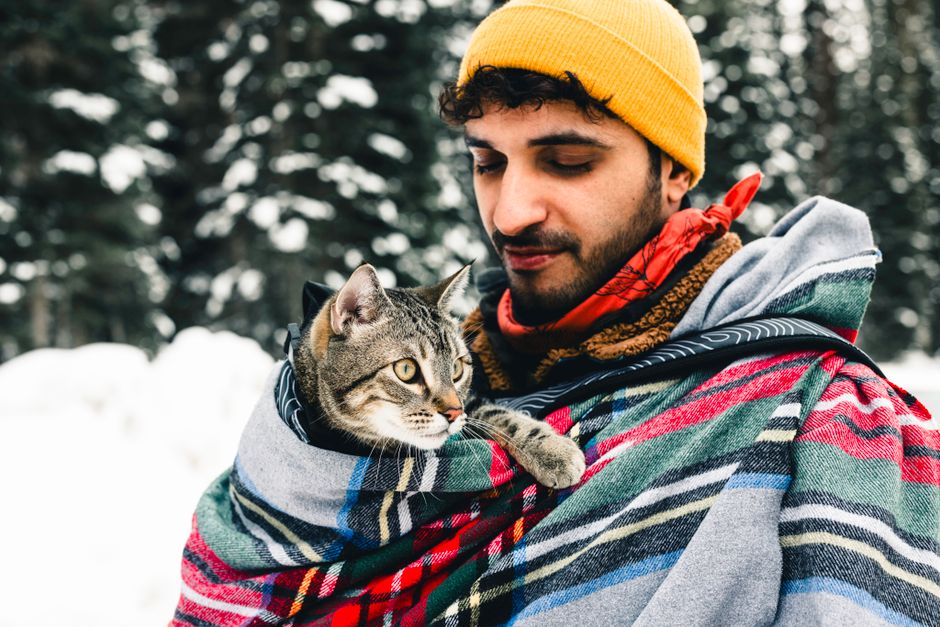
Method 3: Pillowcase Pouch
Materials: one standard cotton pillowcase. A belt, or a length of nylon webbing about 1.5 metres long. Two knots. The pillowcase is the pouch. The belt is the strap. This is the closest a diy cat sling carrier gets to the shape of a bought one.
-
1
Fold the pillowcase
Lay it flat, open end toward you. Fold the bottom third up. About 40 cm deep.
-
2
Tie on the belt
Gather each top corner into a tight bunch. Tie the belt to each corner with a firm overhand knot. About 1 metre of belt between the knots.
-
3
Put it on
Belt over one shoulder, pouch across your chest. Shorten the belt until the pouch floor sits at your ribs.
-
4
Load the cat
Open the mouth of the pouch. Lower her in, hind end first. Harness on, leash led out through the opening.
-
5
Let her settle
She can sit or lie in the pouch. Head and shoulders stay above the rim.
Strength test: load the pouch with the same 2 kg bag of rice. Lift it by the belt. The two corner knots are where it will fail. If the cloth puckers or tears at a knot, tie a knot in the corner cloth first. Then fasten the belt above it.
Where the weight sits: on two small bunches of cotton at the corners. A pillowcase seam was sewn to hold a pillow. Not a 4 kg cat leaning on one side.
Failure points:
- A corner knot: it pulls through the cloth.
- A deep pouch: she cannot see out, and panics.
- The buckle: it presses into her back.
Turn the buckle to the outside.
One more caution. A cat who dislikes being held fights harder in a pouch than in the open scarf. She cannot brace her feet. Read whether a sling works for cats that hate being held before trying this one on a lap-leaver.
About Crochet Slings
A crochet cat sling turns up in every roundup. We would not rank it with the three methods above. Crochet stretches under load. The pouch gets longer, and the holes open with every step.
It suits a kitten or a very small adult, and only if the maker knows load-bearing stitches: tight single crochet, doubled, with a woven strap sewn on. Have the pattern but not the experience? Use a scarf.
Reading Your Cat
The test is the cat's answer. So watch her, not the knot.
😌 She is coping
Loose body, weight sinking into the cloth. Ears forward or relaxed. Slow blinks. Tail hanging or curled, not lashing.
✋ Stop now
Rigid legs. Tail thrashing against your side. Ears flat. Open-mouth breathing. Yowling. A sudden freeze.
International Cat Care's guide to stress in cats lists freezing and hiding among the signs of a stressed cat. A still cat in a sling is not a calm one.
See a stop sign? Lower her out and end the session. Try again tomorrow for a shorter time. Or accept that she prefers a carrier. That is the test working.
When to Buy Instead
Three calm indoor sessions in the T-shirt or the scarf mean the test worked. She can stand the carry. What you still lack is a sling built to do it every week. A made sling adds four things:
- A safety clasp. A short tether inside the sling clips to the harness. A startled cat is caught by the clasp, not by your reflexes.
- A breathable panel. Mesh or open-weave cotton where her body meets yours. A folded shirt traps heat against her ribs.
- An adjustable strap. A buckle sets the pouch height in seconds and keeps it there. A knot slips lower with every wear.
- Load-bearing seams. Stitching made for a cat's weight. Not for a pillow or a neckline.
That is why we moved our own box-refuser from a knotted shirt to a made cat sling carrier. She wears it for the walk from the front door to the car. The ComfyPaws Sling is the one we use: a cotton body with a breathable panel, an adjustable strap, and a safety clasp for the harness. Check the listed weight limit before ordering. It does the door-to-car walk and nothing more. Once the car moves, she rides in a secured carrier. Same rule as for any sling.


After the T-shirt test passes
The step after the T-shirt
Three calm sessions in a T-shirt tell you she can ride against your chest. The ComfyPaws Sling is built to do that every week: cotton body, breathable panel, a strap that adjusts, and a clasp for her harness. Check the listed weight limit first. It is for the walk to the car; in the car, she rides in a secured carrier.
See the ComfyPaws SlingIf the test failed, that is also an answer. A cat that goes rigid in a T-shirt will go rigid in a bought sling. A carrier that opens from the top is the better money. Our cat sling versus a traditional carrier comparison works through that choice.
For hiking, or anything past the doorstep, no diy cat sling is the tool. Our guide to the best cat sling carriers ranks the made options for the cats that passed the T-shirt test.
Questions this guide did not cover
Can I add a safety strap to a homemade sling?
Yes, but treat it as a backup for your hand, not a swap. Tie a short cord or spare leash to the knot and clip it to her harness. Cats.com says even the built-in straps on bought slings are not foolproof: the strap keeps the cat off the ground, but a jumping cat can still hurt herself or slide out of her harness.
Is a DIY sling OK for a big cat, 6 kg and up?
Treat the answer as no. Bought slings publish a limit; the three picks in the Cats.com review are rated 15 lb, 15 lb, and 6 to 18 lb, about 7 to 8 kg at the top. A T-shirt has no rating, and the rice bag in the strength test is less than half of a big cat. Start with our guide to carriers for large cats instead.
My cat has weak back legs. Will a sling help her walk?
That is a different object. A walking support sling goes under the belly, with you holding the ends like handles, so the back legs take less weight. The Handicapped Pets forum has homemade versions, made for a dog but the same shape: a folded sweatshirt strip with two leashes stitched on as handles. The poster notes it puts pressure on the spine, so ask your vet which kind your cat needs first.
Can I use a DIY sling for a kitten?
Yes. A kitten is the one case where a light cloth is not the weak point, because the load is small. The risk moves to the opening: a kitten fits through a gap an adult cannot, so keep the top gathered until only her head is out, and use a kitten-size harness. Our kitten socialization sling guide covers the harness-and-tether rule and keeping sessions under ten minutes.
Related reading
- Best Cat Sling Carrier 2026: Honest Guide, Tested
- Cat Sling vs Traditional Carrier: Safety and Comfort Guide
- Cat Sling Carrier Reviews: Real 30-Day Test Results
- Cat Sling for Cats That Hate Being Held: Does It Actually Work?
About this article
Written by the PetzyMart Team. Sources include the AVMA, AAFP, International Cat Care and Fear Free, linked where each claim appears in the text. Reviewed and updated September 8, 2026. For medical decisions about your individual cat, always consult your veterinarian.


