Should You Cover a Cat Carrier With a Blanket? When It Helps, When It Backfires

By the PetzyMart Team · Sources linked in the text · Last updated: September 8, 2026
The carrier is on the front seat. Your cat is inside. She is watching every car, every tree, and every person that goes past the window. The crying started before you left the driveway.
Should you cover a cat carrier with a blanket? For most cats, yes. Put a light cloth over three sides. Leave the door side open to the air. Never cover all four sides.
That is the short answer. The rest of this guide covers five things:
- Why a cover calms most cats
- Which cats get worse under a cover
- How to put the cover on so it stays put
- How much to cover at each step of the trip
- What it means if your cat still cries under the cover
Why a Cover Calms Most Cats
A cat in a carrier has lost her two best tricks: running away and hiding. She can see everything through the mesh. She cannot get away from any of it. So her eyes go wide, and the crying starts.
Take the view away, and you give her the hiding trick back. A scared cat looks for a small, dark, closed-in spot. A covered carrier is the closest thing to that on the back seat of a car.
The experts agree. International Cat Care says to cover the carrier with a cloth or towel while you travel. It also says to put bedding she sleeps on inside. The American Association of Feline Practitioners says the same in its guide to vet visits. A towel or blanket that smells like home, draped over the carrier, helps her feel safe.
Blanket, towel, or sheet? The cat does not care. What matters is this: the cloth blocks her view but lets air through. A cover is a curtain, not a lid.
A cover also cuts down on noise. And the smell of her own bedding gives her something to bury her nose in.
One limit. If the carrier itself is what scares her, a cover will not fix that. Read why cat carrier anxiety happens for the real cause.
When Covering Backfires
Every article on covering says "check the air flow" in one line. Here is what that line hides.
Heat is the real danger. A plastic carrier only breathes through the door and a few slots. Put a fleece blanket over three sides in a warm car, and it becomes a box with one vent. A parked car heats up fast. A cat cannot sweat to cool down.
Pick the cloth by the weather
FleeceHolds heat. Only when the car is cold.
Bath towelBlocks view and some noise. Dries damp paws.
Cotton sheetBlocks the view, holds almost no heat.
How much hotter it gets inside a parked car
Same rise on a 70°F day or a 110°F day. Cracked windows do not help.
Run the air first. Then load the cat.
And turn the air on before the carrier goes in the car. Never after.
🐱 Cats that calm down by watching you
A cover takes away the one thing that was working.
🤢 Cats that get car sick
Some feel sick watching the side window. A cover fixes that. Others do better facing forward, like a car-sick person.
⚠️ Is the cover making things worse? Check for:
- Mouth-open panting, or hot ears
- Damp paw prints on the carrier floor
- Clawing at the cloth, not pressing into a corner
- Crying gets louder after the cover goes on
- Quiet with the cover half off, crying again when you drop it
How to Cover the Carrier
The method is simple. But "three sides, tucked in" is not the same as a blanket thrown over the top. Here are the five steps.
-
1
Pick the cloth for the weather
Use the three-box chart above. Sheet, towel, or fleece.
-
2
Put something that smells like home inside
A blanket or T-shirt she has slept on, on the carrier floor.
-
3
Drape the cloth over three sides
Top, back, and both long sides. Door side stays clear.
-
4
Tuck it so it cannot slide
Under the handle, or two binder clips at the back.
Why: when you brake, a loose corner slides over the door.
-
5
Check the air
Slide a hand in through the door. The back should feel as fresh as the front.
A trick for small carriers. A pillowcase slides right over a small soft carrier, with the opening at the door end. It cannot slip. It cannot bunch up. And it goes in the wash with everything else.
A cover only works if it stays where you put it. A cover that has slid over the door is the number one reason a cat goes quiet on the way out. Ten minutes into the drive, she starts panting.

Covering by Stage
How much to cover changes between your front door and the exam table. Here is how we do it.
| Stage | Cover | Why |
|---|---|---|
| Loading at home | Cover three sides first. Then lower the cat in. | She goes into a dim den, not a bright box. |
| In the car | Carrier belted on the back seat or on the floor. Three sides covered. No vent blowing on it. | Motion plus a moving view is the worst combo. |
| Waiting room | Carrier up on a chair or your lap. Sides covered. Door facing you. | On the floor, dog noses are at her eye level. |
| Exam room | Fold the cover back, or lift the lid off. | Let her come out on her own, or be checked in the bottom half. |
Our own cat will not go in a box at all. So her trip looks a little different. She rides against our chest in a sling from the front door to the car. Once the car starts, she moves into a belted-in carrier with the cover on. In the parking lot, she goes back into the sling for the walk into the clinic.

The waiting room is where the cover earns its keep. Fear Free says to keep the carrier off the floor and to cut down on what the cat can see. A covered carrier on a chair puts the dog on the next bench out of sight and out of reach.
Lots of people search "cover cat carrier at vet." The answer is yes, right up to the exam room door. Once inside, lift the cover so the vet can see her, and she can see the room slowly. Read taking an anxious cat to the vet for what to ask the clinic to do next.
The Cat Carrying Blanket Question
Many people who search "cat carrying blanket" mean something else. They mean wrapping the cat in a blanket or towel to pick her up. That is a way to hold her. It is not a carrier. She should never ride in the car wrapped in a blanket on your lap.
The towel wrap does one job well. It gets a tense cat through the ten seconds between the floor and the carrier without claws. Here is how:
- Lay a bath towel flat.
- Set the cat in the middle, facing away from you.
- Fold one side over her shoulders. Then the other side. Her front legs are held against her body. Her head stays out.
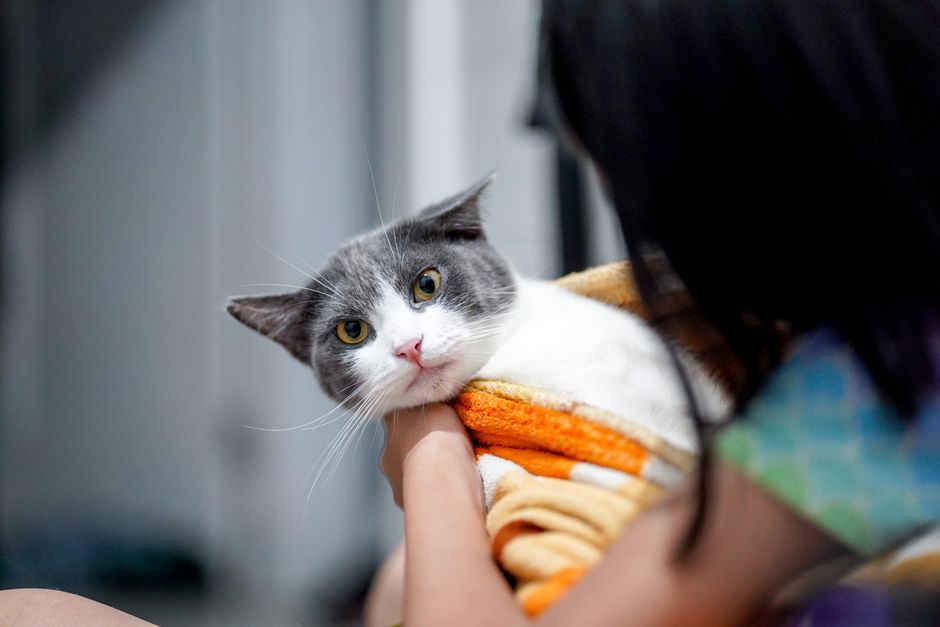
Do not pull it tight. Snug enough that she cannot swing a paw is the whole point. Tighter than that, and she fights it. Then lower her, towel and all, into a top-opening carrier. The towel becomes her bedding.
Want the full no-chase method? It covers where to put the carrier and how to walk up to her. It is in how to get a cat into a carrier without fighting.
One limit. The towel wrap fixes the loading moment, and only that. It does nothing for the drive, the waiting room, or the cat who runs when she sees the carrier come out. Those need the cover, the stages above, or something other than a box.
Still Crying Under the Cover?
You covered three sides. The car is cool. She is still crying. Work down this list before you decide the cover does not work for her.
- The cover slid over the door, and she is short of air. Lift it, tuck it, check with your hand.
- The cloth is too heavy for the day. Swap fleece for a sheet.
- The car warmed up while you loaded her. Run the air before she gets in, not after.
- She wants to see you. Fold back the side that faces your seat. Leave the rest covered.
- She is car sick. Try the carrier facing forward with the front clear, on a short drive.
If she goes quiet after one of these changes, you have your answer. It was never about the cover.
Nothing on the list helped? And she was already crying in the house, before the car moved? Then the problem is not what she can see. It is the box itself. A cover fixes a seeing problem. A cat who panics when the carrier comes out has a fear-of-the-box problem. That is where the carrier anxiety guide starts.
For that cat, a cover will not fix the walk to the car. A body-close cat sling carrier for the trip from the front door to the car is the other option. Then a belted-in carrier once the car moves.

For the cat that hates the box
Is the box the problem, not the view?
If your cat cries the same with the cover on or off, the cover is fixing the wrong thing. For the walk from your front door to the car, the ComfyPaws sling holds her against your chest instead of in a box. Soft cotton, a strap that adjusts, and a safety clip. Once the car moves, she still rides in a belted-in carrier.
See the ComfyPaws SlingFor every other cat, a cat carrier blanket is the cheapest thing you will ever do for vet day. Three sides. Light cloth. Tucked so it stays. Off again at the exam room door.
Questions this guide did not cover
Can I spray Feliway on the blanket?
Yes. Spray the blanket that goes inside the carrier, and do it early. International Cat Care says to spray at least 15 minutes before the cat goes in. Preventive Vet suggests 8 to 10 pumps on the bedding. Do not spray while she is inside. The spray needs those minutes to dry.
Does a blanket inside stop her from sliding around?
A folded towel on the floor gives her grip on smooth plastic. But the bigger slide is the carrier itself, on the seat. International Cat Care says to belt the carrier in and set it on a towel or pad. That keeps it level and soaks up any accident. Level carrier plus a towel floor, and she stops bracing at every corner.
Do I need to buy a special carrier cover?
No. Most covers sold for carriers are fleece. That is the one cloth this guide keeps out of a warm car. A fitted cover can also close off the door side you need open. A pillowcase over a small soft carrier, or a bath towel with two binder clips, does the job. And it goes in the wash.
Should I cover the carrier on the way home too?
Yes. The trip home is a second car ride, and now she smells like the clinic. The cover works the same way. Once home, International Cat Care says to wash the bedding from the carrier to get the clinic smell out. This matters most if you have more than one cat. A cat that smells wrong can get hissed at by the others.
Related reading
- Cat Carrier Anxiety: Why It Happens & How to Fix It
- How to Get a Cat Into a Carrier Without Fighting
- How to Calm a Cat During a Car Ride
- Taking an Anxious Cat to the Vet: What Actually Helps
About this article
Written by the PetzyMart Team. Sources include the AVMA, AAFP, International Cat Care and Fear Free, linked where each claim appears in the text. Reviewed and updated September 8, 2026. For medical decisions about your individual cat, always consult your veterinarian.


