Kitten's First Vet Visit: What to Expect, What to Bring, and How to Get There Calmly

By the PetzyMart Team · Sources linked in the text · Last updated: September 8, 2026
The kitten came home on Saturday. By Tuesday she has claimed the sofa. The adoption papers on the fridge say one thing in capital letters: book the vet.
Book your kitten's first vet visit within the first week home. Most kittens have that first visit at six to eight weeks old. The vet will check her from nose to tail. She will look for parasites. She will start the core vaccine series.
Every clinic blog covers that part. What they skip is the trip. They give it one line about "a secure carrier." But a kitten's first vet visit is also her first carrier. Her first car ride. Her first waiting room. What she learns that morning is what she will expect from every vet trip for the next fifteen years.
So this guide splits its space in half. Half is the visit. Half is getting there and home again without a scare. Have an older cat who already dreads the clinic? Our pillar on how to take your cat to the vet without stress covers the repair job. This guide is about not needing it.
When to Book the Visit
Book within the first week. Book sooner if the shelter or breeder contract asks for it. Many adoption papers ask for a vet check within three to five days. A kitten who has just changed homes is also the kitten most likely to be carrying something.
Some signs mean you should not wait for the booked slot. Call the same day if she:
- Sneezes, or has eye or nose discharge.
- Has loose stool.
- Is not eating.
Any one means a same-day call.
Age matters less than most owners think. A first vet appointment for a kitten usually lands at six to eight weeks. That is when kittens leave their mothers. It is also when the first vaccine is due. But a twelve-week-old rescue still needs the same visit. The vet simply starts the schedule from wherever she is.
Plan for thirty to forty-five minutes in the room. Block out an hour. Costs vary by clinic and by region. A new kitten vet appointment often bundles the exam with a vaccine, a stool test, and a blood test. Ask for an estimate when you book, not a blog's number.
Three things are worth asking on that booking call:
- Stool sample: do they want one, and how fresh does it need to be?
- Cat-only space: is there a cat-only waiting area, or cat-only appointment times?
- First slot of the day: what time is it? Take it. The waiting room is empty. The schedule has not slipped yet.
Ask before you hang up.
What the Vet Will Do
The first visit sets a baseline. The vet checks three things. Is your kitten healthy? Did she arrive with a common kitten problem? What protection does she need?
A full vet check for kittens runs nose to tail. It looks like a lot of handling. But each step has a target:
| Exam step | What the vet is looking for |
|---|---|
| Weight | Is growth on track? Sets the dose for dewormer and flea prevention. |
| Temperature | Fever, which can signal infection. |
| Eyes, ears, mouth | Discharge. Ear mites. Baby teeth coming in. Cleft palate. |
| Heart and lungs | A murmur. Congestion. Hard breathing. |
| Abdomen | Umbilical hernia. Worm load. A sore belly. |
| Skin and coat | Fleas and flea dirt. Ringworm. Mites. |
| Fecal exam | Roundworm. Hookworm. Coccidia. Giardia. |
| FeLV/FIV blood test | Feline leukemia and feline immunodeficiency virus. |
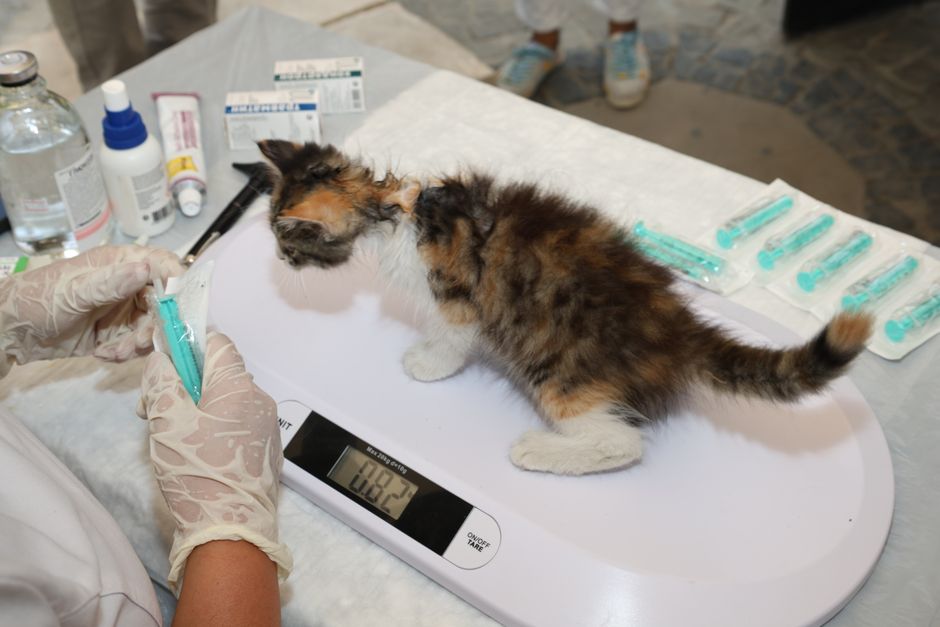
Two tests surprise new owners. The stool test is one. Gut worms are so common in kittens that most vets treat as if they are there. The second is the blood test. It takes a few drops from a leg vein. It tells you if your kitten can safely live with other cats.
Vaccines and Deworming
The core kitten vaccine is FVRCP. It covers feline viral rhinotracheitis, calicivirus, and panleukopenia. We will not give you a schedule of our own. The AAHA/AAFP Feline Vaccination Guidelines already set one. Kittens get the first dose no earlier than six weeks. Most get it at six to eight weeks. Then one dose every three to four weeks, until she is sixteen to twenty weeks old.
Why so many doses? A kitten gets some immunity from her mother's milk. It fades at some point in that window. Each shot is a fresh try to land after it has gone. Skip the last one, and you leave a gap.
Rabies comes once she is old enough. The law requires it in most places. So the timing follows your local rules. Your vet may also suggest the FeLV vaccine. That one is for kittens who will be around other cats.
Deworming is routine at the first visit. It is repeated at the follow-ups. Most flea products are labelled for eight weeks and up. If your kitten is younger, the vet will comb instead of dose. The Cornell Feline Health Center has a plain page on this. It says what each vaccine protects against. It also says what a normal reaction looks like. Read it before the visit, not after.
Microchip and Spay Timing
A microchip can go in at this visit or the next one. It is a quick injection. It is no heavier than a vaccine. And it is the only ID that survives a lost collar.
Spay or neuter timing is a talk at this visit, not a procedure. Your vet will set the date by your kitten's weight and age. Ask what they suggest. Write it down.
What to Bring
New kitten vet visits go faster when the vet has the history in hand. They also cost less in follow-up calls. Pack this the night before:
🧳 Pack the night before
- Records: adoption or breeder papers, with any vaccine and deworming dates already done
- Medication: anything she takes, in its original box
- Stool sample: only if the clinic asked. From that morning, in a sealed bag
- Your questions: written down. You will forget them once she starts climbing the vet
- Her towel: the one she has been sleeping on
- Her food: the name, and how much she eats
The towel does two jobs. It lines the carrier, so the whole trip smells like her bed. Then it goes on the exam table, so the cold steel does not touch her.
Questions Worth Asking
Read these off your list. Vets like owners who ask. It means the advice will be followed.
- Food: what should she eat? How much? How many meals a day?
- Vaccines: when is the next one due? How many are left?
- Worms and fleas: what is the plan for the first year?
- Spay or neuter: when do you recommend it?
- Outdoors: indoor only, or supervised time outside later?
- Microchip: is it registered, and to whom?
- Warning signs: which ones mean we should call the same day?
- Emergencies: what are your hours? Where do we go after hours?
Write the answers down.
One more, if you have time: ask about behaviour. Vets give advice on play, handling, and litter habits at kitten visits. That advice has been shown to cut problem behaviour later on. The first visit is when vets are most willing to talk about it.
Owners who got behaviour advice at the first kitten visit reported fewer problems
91 kittens. Half the owners got advice at the first visit. All were asked again 10 months later.
Ten minutes of talk at this visit cut the odds of a problem by more than half. Ask.
Introduce the Carrier First
Here is the part that decides vet day. It is either a non-event, or a wrestling match for the next ten years.
Kittens are in a socialization window. It closes somewhere between nine and fourteen weeks. New things in that window get filed as normal or as a threat. The filing tends to stick.
Picture a kitten who is scooped up and pushed into a box that smells of plastic. She is driven for twenty minutes. Then she is set down next to a barking Labrador. She has just filed "carrier" under threat. She is the cat who hides when the carrier comes out at age six. Our own box-refuser got that way exactly like this. Undoing it took months. The same window is why a kitten socialization sling is worth using in these weeks for other new places too.
So give the carrier three days before the visit:
-
1
Day one: make it furniture
Take the door off. Put the carrier in the room she sleeps in, with her towel inside. Ignore it.
-
2
Day two: make it the food bowl
Feed her meals in it. Drop treats in it when she is not looking.
-
3
Day three: make it move
Door on. Close it for ten seconds while she eats. Open it. Treat. Then lift the carrier, walk to the next room, set it down, open it.
Why: the lift and the walk are the two moments a kitten has never felt before.
Three days is the minimum.
Choose a carrier with a top opening, or a lid that lifts off. Size it for a kitten, not for the adult cat she will become. Lowering a kitten in from above is calm. Pushing her through a front door is the move that starts the fight. A top-opening carrier also lets the vet check her where she sits. Most cat-friendly clinics prefer that. Wondering how long a kitten can stay inside one? See the kitten section of how long can a cat stay in a carrier.
The Trip Itself
Once the carrier is familiar, the trip is a sequence. Each stage has one job.
| Stage | Do this | Why |
|---|---|---|
| Before leaving | Load her from above. Towel inside. Towel draped over three sides. | Her scent and a dark den. Less to look at. |
| In the car | Carrier on the back-seat floor, or belted on the seat. Cover on. Windows up. | A loose carrier slides. Wind and noise frighten her. |
| Parking lot to door | Carry the carrier level, in both hands. Or use a body-close sling for the walk. | A swinging carrier feels like a fall. |
| Waiting room | Carrier raised on your lap or a chair. Cover on. Away from dogs. | Floor level is where the dogs are. |
| Exam room | Open the top. Let her come out, or let the vet lift her. Towel on the table. | Being tipped out of a carrier is the worst moment. |
The waiting room rule comes from International Cat Care. Its guidance on the waiting room says to keep the carrier off the floor, covered, and as far from dogs as the room allows. A kitten at floor level is eye to eye with everything that walks in.
There are two short walks: front door to car, and parking lot to clinic door. For those, we carry a small kitten in a body-close cat sling carrier, not a swinging box. Our kitten wears a vest harness. It clips to the ComfyPaws sling's safety clasp. She rides against our chest, where she can hear a heartbeat. We have a hand free for doors and the check-in desk.

That is the whole job of the sling: a few minutes of walking. Once the car starts, she is in the carrier, belted in, with the cover on. A sling is not a car restraint. It also does not suit a kitten who dislikes being held. And it has a listed weight limit to check as she grows.
Visit tomorrow, with no time for this? Our same-day guide to preparing your cat for the vet packs the carrier work into one evening.
After the Visit
Bring her home to one quiet room. Give her water, food, and a litter tray. Set the carrier down with the door open. Let her come out in her own time. Other cats in the house? Keep them apart for a few hours. She smells like the clinic, and they will notice.
Mild reactions in the first twenty-four to forty-eight hours are normal. The Cornell page above lists them: sleepiness, a little less appetite, a tender spot where the shot went in, and a low fever. Skip the play session. Keep the room warm. Check on her at bedtime.
Call the clinic the same day if you see any of these:
🚨 Call the clinic the same day if you see:
- Swelling of the face or muzzle, or hives
- Vomiting or diarrhoea that repeats
- Trouble breathing, or breathing that looks like effort
- Weakness, or refusing food for more than forty-eight hours
- A lump at the shot site that is still there three weeks later
Then leave the carrier where it is. It has just become her bed. The next shot is in three to four weeks. A kitten who naps in the box she rides in has already done the hard part of the next trip.
That is the whole shape of a kitten's first vet visit. A booking in the first week. A thirty-minute exam that sets her baseline. A vaccine schedule you can read straight from the guidelines. And three days of carrier work that buys a lifetime of easy visits. For the short walk between doors, the ComfyPaws sling is the piece that kept our own kitten calm.

For the walk between doors
A sling for the walk in, not for the drive
Two short walks are where a swinging box scares a kitten: front door to car, and parking lot to clinic. The ComfyPaws sling holds her against your chest for those minutes. Soft cotton, a mesh panel for air, a strap that adjusts, and a safety clasp for her harness. In the car, she still rides in a belted-in carrier.
See the ComfyPaws SlingQuestions this guide did not cover
Is the lump after her shot cancer?
Almost never. A small, firm bump under the skin after a vaccine is common. The AVMA says it should disappear within a couple of weeks. A tumor at the shot site, called an injection-site sarcoma, is rare: about 1 cat per 10,000 to 30,000 vaccinations. A bump that is still there after three weeks, or one that is growing, needs a vet to look at it.
Does an indoor kitten need the FeLV vaccine?
For the first year, the guidelines say yes. The 2020 AAHA/AAFP Feline Vaccination Guidelines list FeLV as a core vaccine for cats younger than one year. After that, it becomes a choice based on risk. International Cat Care says the vaccine is most valuable for cats that go outside and meet cats of unknown status. Tell your vet how she will live.
When is her first booster after the kitten shots?
About one year after the last kitten dose. International Cat Care says the first booster is given 12 months later. After that, boosters may only be needed every one to three years, depending on the vaccine and the cat. Put the date in your calendar before you leave the clinic.
How often does she see the vet once the kitten series is done?
Once a year, then twice a year when she is old. PetMD says kittens visit often in the first 16 to 20 weeks, adult cats need at least one wellness exam a year, and cats over ten should go every six months.
Related reading
- How to Take Your Cat to the Vet Without Stress (2026 Guide)
- Kitten Socialization Sling: Bond & Carry Your Scared Kitten Safely
- How to Prepare Your Cat for the Vet Tomorrow (Same-Day Guide)
- How Long Can a Cat Stay in a Carrier? Vet-Approved Limits (2026)
About this article
Written by the PetzyMart Team. Sources include the AVMA, AAFP, International Cat Care and Fear Free, linked where each claim appears in the text. Reviewed and updated September 8, 2026. For medical decisions about your individual cat, always consult your veterinarian.


