How to Take Your Cat to the Vet Without Stress
By the PetzyMart Team · Sources linked in the text · Last updated: September 19, 2026
The carrier comes out of the closet. Your cat is gone before you turn around.
Vet day does not have to go like that. Start two weeks early. Leave the carrier out where she sleeps. Take two short car rides with no destination. Ask your vet whether she needs medicine for the visit. In the car, keep the carrier low, covered, and still.
Almost all of the work happens before the day itself. None of it is hard. It just has to start early.
You are also not the only one who dreads this.
This guide runs the whole thing. Two weeks out, the morning of, the waiting room, and the drive home.
Cat Vet Visit: Three Basics
Before the timeline, three choices shape the whole day.
What to bring
- Vaccine and medicine records. A phone photo is enough.
- A towel or blanket she already sleeps on. Familiar smell, and it doubles as the cover.
- A few treats she rarely gets. Freeze-dried chicken beats kibble.
- Your questions, written down. You will forget them in the room.
- A stool sample, but only if the clinic asked for one.
Which carrier
Pick the format by what she actually does
Top-opening carrierThe lid lifts off. You never have to tip her out.
Soft-sided carrierLighter to hold, quieter on the seat, folds away at home.
Add a hands-free slingWorn on your body, for the walk from car to door.
We ranked the formats in our guide to the best cat carrier for vet visits. If you are stuck between two types, read soft-sided vs hard carriers.
When to go
- Book the first slot of the morning. The waiting room is empty then.
- Ask whether to hold breakfast. Fear Free Happy Homes says a cat who has not just eaten takes the clinic's treats and is less likely to be car sick. Some tests need fasting anyway.
- Leave ten minutes earlier than you think. Loading under time pressure goes badly.
Visit is tomorrow and none of this is done? Use the same-day prep guide instead.
Two Weeks Out
Get the carrier out today. Not the night before.
Put it where she already sleeps. Take the door off, or tie it wide open. Drop in a blanket she has used.
Then feed her near it on day one. Just inside the door on day two. All the way at the back by day three.
The carrier has to stop meaning vet. It has to start meaning food. Why that one change moves the whole visit is in the science of a calmer carrier.
Only have a week? Run the short version instead: our 7-day transport training plan.
Now call the clinic. Ask about cat-only hours, or a separate room for cats. International Cat Care accredits clinics under a Cat Friendly Clinic scheme, and says to look for one.
If she runs at the sight of the carrier, training alone will not fix it. Start with why carrier anxiety happens.
One Week Out
Now the car.
Take two or three short drives with nowhere to go. Around the block, home again, treats. Motion plus treats builds a new habit.
This is also the week to call about medicine. Some cats need more than training. Vets do prescribe something for the visit, and your vet decides the drug, the amount, and the hour. Ask now, not on the morning. You need the prescription, and you want a trial run at home first.
For the ride itself, we go deeper in how to calm a cat during a car ride.
The Last Three Days
Supplements. If your vet suggested a calming supplement, start it now. The label says how many days ahead. These are not sedatives.
Scent. Spray the carrier bedding with a synthetic cat pheromone. International Cat Care says to spray it at least 15 minutes before your cat goes in. Never spray it on your cat. Our honest read on whether it works is in does Feliway work for cat transport.
The bag. Pack it the night before, not at 7 AM:
- The records and your written questions.
- A spare towel, in case she soils the first one.
- The treats.
- Your phone, charged, for notes in the room.
The carrier. Put it somewhere you can reach without rummaging.
Morning-Of Prep
This is go time. Run it in this order.
-
1
Give the medicine
At the hour your vet named. Not earlier, not in the car.
-
2
Refresh the scent
Same spray, same 15-minute head start as above.
-
3
Open the carrier in a quiet room
Door wide, treats at the back, nobody standing over it.
-
4
Let her walk in
If she will not, use the towel wrap below.
-
5
Drape a light towel over it
Top, back and sides. Leave the door end open for air.
-
6
Pick it up from underneath
Both arms under the base, not the handle.
Why: International Cat Care warns against swinging it or banging it against your legs.
-
7
Carrier into the car
Floor behind a front seat. Never the passenger seat.
-
8
Radio low, driving smooth
No hard stops, no sharp turns, no shouting over music.
Towel-Wrap Technique
Do not chase her through the house. Get a big towel instead.
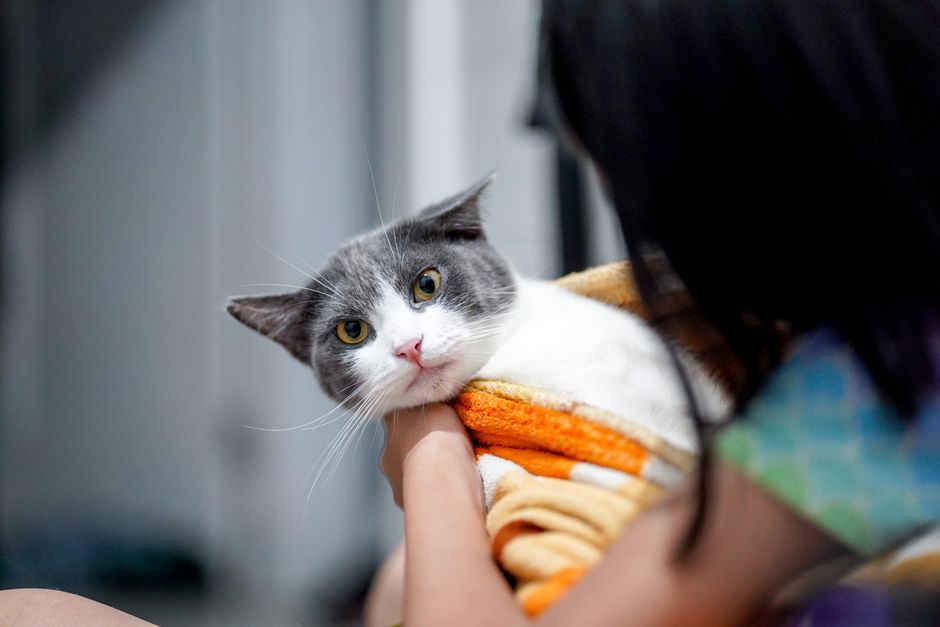
Lay it flat. Set her in the middle, facing away from you. Fold one side over her shoulders, then the other. Her front legs end up against her body. Her head stays out.
Snug, not tight. Then lower her, towel and all, into a top-opening carrier. The towel becomes her bedding.
The full version is in how to get a cat into a carrier without fighting.
At the Clinic
First thing inside: get the carrier off the floor. A chair, a shelf, your lap. Dog noses are at floor level. Keep the towel over it.
If the room is loud, ask to wait in the car. International Cat Care says to do exactly that when a cat is very stressed.
In the exam room, let the vet lead. The 2022 AAFP/ISFM handling guidelines say the top half of a carrier can come off, so a cat who will not come out is examined in the bottom half. Ask for that.
The walk from the parking lot to the door is its own problem. For a cat who will not be carried in a box, a cat sling carrier is one way to cross it. We compared the hands-free formats separately.

What we actually use
The parking lot is where it usually falls apart
Our own cat has never walked into a box willingly. She goes front door to car in the ComfyPaws sling, and car to clinic the same way. Soft cotton, a mesh panel, an adjustable strap, a safety clip. It has no crash rating, it does not replace a secured carrier for the drive, and it will not help a cat who hates being held.
See the ComfyPaws SlingAfter the Visit
Same rules going home. Covered, low, quiet. Do not open the door to check on her.
At home, set the carrier down in a quiet room and open it. Then walk away. Do not lift her out. Do not call the kids in to look.
She comes out when she is ready. That might be five minutes or fifty.
Some cats stay cold for a day or two. She is not sulking. She is settling. If it drags on, we wrote a 7-day plan for rebuilding trust. Still hiding a week later? That is closer to vet-visit trauma.
Last thing: write down what worked. Which slot, which carrier, which medicine. Next year you start from notes instead of memory.
Calming Aids Compared
Most cats do not need a calming aid. For the ones that do, here is what each thing actually is.
| Question | Gabapentin | Supplements (Zylkene, Composure) | Feliway |
|---|---|---|---|
| Do you need a vet? | Yes. It is a prescription. | No. | No. |
| When do you start? | Your vet sets the day and the hour. | Days ahead, per the label. | Ahead of loading, not as she goes in. |
| How is it given? | By mouth. | By mouth. | On the bedding. Never on the cat. |
| What it will not do | It will not teach her to like the carrier. | They are not sedatives. | It is a layer, not a fix for panic. |
One rule with no exceptions. Never give your cat a human pill unless your own vet told you to. The amounts are not the same as ours.
Your Stress Matters
Your cat reads you.
International Cat Care puts it plainly. Stay calm so your cat does not pick up stress from you. Keep your voice down and the radio low. Fear Free Happy Homes puts it the same way: manage your own energy before and during the visit.
So lay everything out the night before. Move slowly in the morning. Use your normal voice, not the high "it's okay, baby" voice. In the waiting room, sit down and stop narrating.
And put the guilt down. You are doing this so she gets old and stays well. If that feeling is heavy, read why you feel guilty taking your cat to the vet.
Emergency Vet Trips
Sometimes there is no two weeks. She is limping, or throwing up, and she has to go now.
🏥 Go in today
The only option if she may need bloods, imaging or fluids.
🏠 Call a house-call vet
The exam happens in your living room. No car, no dogs, no clinic smell. It costs more, and it cannot do everything a clinic can.
One warning. If you have leftover medicine from a past visit, call before you use it. In a real emergency your vet may not want her sedated at all.
How Often to Visit
The 2021 AAHA/AAFP feline life stage guidelines say every cat needs a check at least once a year. Senior cats, which the guidelines put at 10 years and older, should be seen at least every six months. More often if she has an ongoing condition. Older cats have their own routine, covered in senior cat vet visits.
Between visits, ask about a happy visit. Some clinics let you bring the cat in for treats and nothing else. No exam, no needles. It costs you twenty minutes and it changes what the building means.
You are not going to make her love the vet. That was never the goal. The goal is a cat who walks into the box, rides quiet, and forgives you by dinner.
Questions this guide did not cover
My other cat hissed at her the moment she got home. Why?
Because she smells wrong. International Cat Care explains that clinic scents both smell strange and mask her own scent, so the other cats can no longer place her as one of the group. Keep them apart for a few hours or a day or two, then let them meet again under supervision. Wash the carrier bedding. Offer her bedding from a spot they all share, so she picks the household smell back up.
What happens if she has to stay in overnight?
Ask to see where she will be kept before you agree. International Cat Care says to look for a separate cat ward, cages that are clean, secure and big enough, and bedding or a box she can hide in. You may be allowed to leave something from home that smells right, and you can ask when you are allowed to visit.
What are the side effects of gabapentin in cats?
Sleepiness and incoordination, according to the VCA Animal Hospitals drug sheet. It should stop working within 24 hours, though the effect runs longer in a cat with liver or kidney disease. VCA flags kidney disease and pregnancy as reasons for extra caution. Report what you see to the vet who prescribed it, and never adjust the amount yourself.
What if she is too frightened to be examined at all?
Going home and coming back another day is a real option. The 2022 AAFP/ISFM guidelines say a caregiver can be asked to take the cat home and book a return visit, with anxiolytic medicine dispensed to give before that one. The same guidelines say heavy restraint and scruffing should be avoided, and that cats examined with minimal handling show fewer negative responses than cats handled with heavier restraint.
Related reading
- How to Get a Cat Into a Carrier (Even One That Hates It)
- Taking an Anxious Cat to the Vet: What Actually Helps
- Senior Cat Vet Visits: How to Make Them Easier as Your Cat Ages
- How to Rebuild Trust With Cat After Vet: 7-Day Recovery Plan
About this article
Written by the PetzyMart Team. Sources include pmc.ncbi.nlm.nih.gov, Fear Free, International Cat Care, VCA Animal Hospitals and AAHA, linked where each claim appears in the text. Reviewed and updated September 19, 2026. For medical decisions about your individual cat, always consult your veterinarian.