Best Hands Free Cat Carrier 2026: 6 Picks and How to Choose
By the PetzyMart Team · Sources linked in the text · Last updated: September 19, 2026
Bag in one hand. Keys in the other. And a cat who has to be at the vet by ten.
That is the job a wearable bag does. It moves the cat and leaves your hands free.
The best hands free cat carrier is the one your cat will settle in. Weight limits and mesh panels come second.
Below are six picks, what to check on each one, and the one job none of them can do.
Wearable Cat Carrier Types
"Hands-free" and "wearable cat carrier" cover three designs.
- Sling. One wide strap over a shoulder. Your cat lies in a pouch at your chest or hip, head out.
- Front pack. Two straps, like a baby carrier. Your cat sits upright on your chest. Some styles let her legs hang out.
- Backpack. A framed box on your back, with mesh sides or a clear dome.
Which design suits which cat is a longer story. We tell it in wearable cat carriers explained.
None of the three is a car-safety device. International Cat Care says never to travel with your cat loose in the car, and to always use a robust carrier. A cat worn by the driver is a loose cat. For the drive she moves into a carrier that is belted in. See is a cat sling safe in the car.
Updated September 2026: we cut the write-ups of models we had never handled, put the makers' own published numbers in their place, and re-read every source page. The airline section changed most. Our old text said more than Delta's rules do. We then named our own bag in the three shapes we sell one, and flagged the specs we do not publish.
What To Check Before You Buy
Five things decide whether a wearable bag gets used twice.
- The listed weight. Most makers print a top cat weight. Some do not. Weigh your cat first.
- Where it opens. A zipper, a hook, a flap. Find the one a paw can push.
- The clip inside. It should clip to a harness. Never to a collar on its own.
- Air on more than one side. Your body blocks a whole side of any bag you wear.
- The wash. Scared cats pee. A bag that cannot go in the machine gets used once.
Miss one of these and the bag ends up in a closet by March.

Measure her as well as weigh her. Nose to the base of the tail is the number that decides fit. Our cat carrier size guide walks through both.
The Six Picks
We built this list from specs the makers publish. We did not run a lab test. Four of the six name something we sell, and we say so each time. We also say where we publish no number and a rival does.
Four of the six have a named example with numbers you can check. The other two are designs, not one product.
| Named example | Maker's top cat weight | Size notes |
|---|---|---|
| ComfyPaws Sling | 19.8 lb / 9 kg | 12.3 oz bag; strap fits 4'11"–6'3" |
| Travel Cat "The Navigator" | 25 lb / 11.5 kg | 18 x 15.4 x 10 in |
| Travel Cat "The Fat Cat" | 25 lb / 11.5 kg | 15 x 11.4 x 17.7 in |
| Cat-in-the-Bag Cozy Comfort | Not published | Four sizes, under 5 lb up to XL |
Every number above comes from the maker's own page, linked in the table. Cat-in-the-Bag is the exception. It prints sizes, but no weight limit.
1. Sling: Short Walks
One strap, one shoulder, your cat half-lying against your chest. It is built for the walk from your door to the car, and from the parking lot to the clinic door.
Our own cat will not go in a box at all. Her trip runs in three parts. Sling from the front door to the car. A belted-in carrier for the drive. Sling again from the parking lot to the clinic door.
The one she rides in is our ComfyPaws cat sling carrier. Cotton outside, a 3D honeycomb mesh lining, a strap that adjusts, and a clip made for a harness.

What it will not do: it is not a car restraint, it will not hold a cat who is set on getting out, and it does nothing for a cat who hates being held. For that cat, read does a sling work for a cat who hates being held.
2. Legs-Out Front Pack
Two straps, your cat upright on your chest, front legs through two holes. It is the closest thing on this list to a baby carrier.
It works for a calm cat on a slow, short walk. It is the worst pick for a wriggler. Legs out means she has your body to push off.
The closed version of the same design takes that away. Ours is the SnugFront front-facing carrier. Two straps, same chest position, but only her head is out. A mesh panel covers the front. It wipes clean, which matters more than it sounds. We do not publish a top cat weight for it, so measure her first.
3. Heads-Out Pouch
A soft bag that closes around the neck. Her head is out, her body is in.
One example is the Cat-in-the-Bag Cozy Comfort Carrier. The maker lists Velcro ports at the front paws, and a zip at the back ones. Nails get cut without unpacking her.
This is a handling tool, not a walking bag. Buy it for nail trims and exam tables.
4. Mesh Backpack
A framed box with mesh windows and no dome. This is the hands free cat carrier backpack people mean when they say adventure cat. One example is Travel Cat's "The Navigator": mesh on all three sides, and two clips inside for a harness.
Ours in this shape is the CloudComfort cat carrier backpack. Mesh panels, a padded floor, and a tether inside that clips to a harness. It opens from more than one side, so you are not posting her through a single hole. Travel Cat prints a 25 lb limit. We do not print one, so weigh her and read the size guide.
Three mesh sides means air from three directions. Your back still blocks the fourth. The catch is where the bag sits. Your cat is behind you, so you cannot see her. Stop and look every few minutes.
5. Bubble Backpack
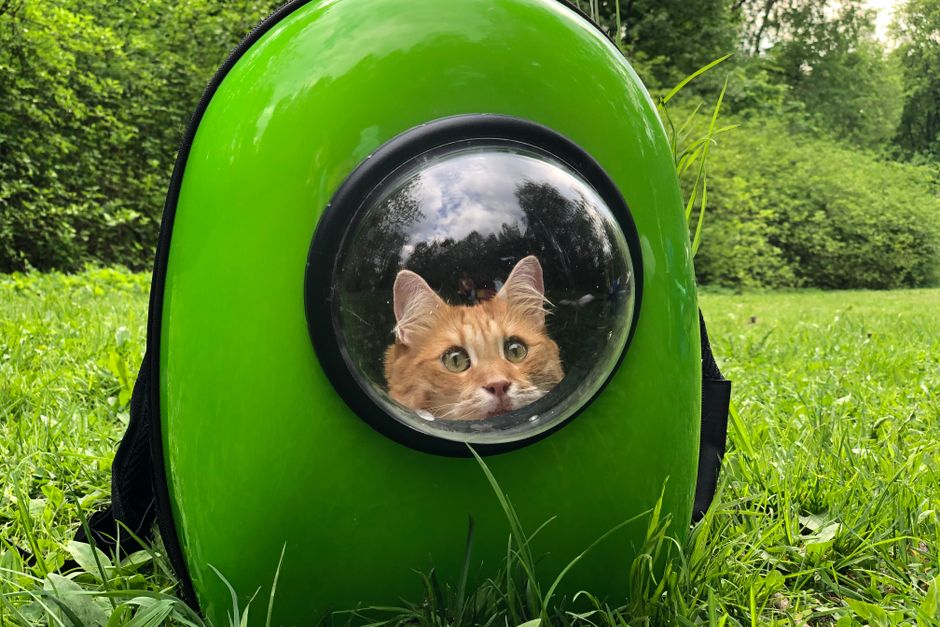
The same box with a clear dome in place of one mesh panel. Travel Cat sells "The Fat Cat" as its version for larger cats.
A bold cat will sit in the dome and watch the street. A shy cat has nowhere to hide, and the dome is the first thing she will press against. Keep any dome out of full sun.
6. Under-Seat Bag
A soft bag with a shoulder strap, sized to slide under an airplane seat. It is not really a wearable. But the strap frees both hands, and it is the one pick here built for a cabin.
Ours is the AirVista cabin carrier, in two sizes. Mesh on the long side and on one end. The top rolls right open, so you can lift her out from above. We do not publish its outside measurements, and that is the number a flight turns on. Measure the bag and your airline's limit before you fly.
It is also the plainest bag on this list. That is the point. Read the next part before you buy one for a flight.
Will It Fly?
"Airline approved" is not a stamp an airline hands out. We read Delta's pet rules. Delta names no brands. It sets requirements, and a bag either meets them or does not.
Two picks here fail before you measure. A sling does not close. A heads-out pouch leaves her head out. Delta wants her secured inside the kennel, in the airport and on board.
Both backpacks do shut. They are just too big. The box below has the numbers.
A smaller backpack that shuts could still pass. Neither of these two is small enough.
"Airline friendly" on a product page is a marketing line, not a seat measurement.
One moment does take her out of the bag. Delta makes you remove her at the security checkpoint. Put the harness on her before you get in line.
After that she goes back in. She stays in through boarding, the flight and deplaning. The one exception is a designated pet relief area.
So the honest plan for a flight is one under-seat bag, and nothing worn. Check your own airline's page too, and check the plane you fly on.
Teach Her To Use It
A wearable only works if she has been in it before vet day.
Fear Free Happy Homes teaches carrier training as very short daily sessions, built up in small steps. The pace is set by the cat, not by the calendar. Here is that ladder for a bag you wear.
-
1
Leave it out
Open, on the floor, in the room where she sleeps.
-
2
Feed her at it
Bowl beside the bag. Then at the mouth. Then inside.
-
3
Lift, do not walk
Clip the harness, lift a hand's width, set her down, treat.
Why: the lift is the part she has never met.
-
4
Walk the hall
Half a minute. Then the yard. Then the street.
-
5
Go somewhere that is not the vet
Round the block, then back to your own kitchen.
Skip a rung and she tells you. She braces, she goes stiff, she starts to slip out. Drop back one rung and stay there a week.
Check It Before You Go
Run this list before you lift her.
🎒 Before you lift her, check:
- Zippers shut, pulls parked at the far end from her nose
- Harness on, clip clipped, collar not doing the work
- Hand slid inside and out again, feeling air and not warm cloth
- A cloth on the floor of the bag that smells like home
- One lap of your house with the bag loaded, to test your shoulder
The last line matters more than it sounds. A bag that feels fine for two minutes in your hallway is a different bag twenty minutes into a walk.
Which One Is Right
Start with the trip, not the bag.
SlingYou need a hand for the door.
Mesh backpackBest airflow, load on both shoulders.
Heads-out pouchHead out, one paw reachable.
Under-seat bagBuilt for the cabin, not for wearing.
And every one of them ends the same way. Once the car moves, your cat rides in a carrier that is belted in. The wearable is for the part of the trip you do on your feet.

For the door-to-car part
Our sling, and its limits
A cotton sling for the part of the trip you walk. Front door to car, parking lot to clinic. The mesh is a lining, not a window, so keep to the shade in July. And it does not belong in a moving car.
See the ComfyPaws SlingQuestions this guide did not cover
Are cat backpacks cruel?
Not on their own. The Vet Desk says that used properly they are not cruel, and that it turns cruel when you force a cat who does not want to go in. Catster is blunter: a cat who shows displeasure in one should not be kept in it.
How long can she stay in a wearable bag?
Plan on an hour or two. Catster's vet-reviewed guide says to get back home for water, food and a bathroom break inside that window. The Vet Desk gives four hours as the outside limit, and says the real number moves with personality, age and health. See how long a cat can stay in a carrier.
Can I carry her into the vet's waiting room in a sling?
Ask the clinic, and expect a no. International Cat Care says to keep your cat in the carrier on arrival, held underneath rather than by the handle, and to ask reception about an area set aside for cats. A room with dogs is the wrong room for an open sling.
Can I cycle with her on my back?
Think about the fall, not the ride. Supakit, a cat harness maker, treats a front carrier, a trailer and your cat backpack as three options, and says the backpack is fine if it is suitable and safe for a bike. It asks two things of whichever you pick: will she stay inside if the bike goes over, and will it cushion her if it hits the ground? It also says any bike basket should be completely secure, breathable and stable.
Related reading
- Wearable Cat Carriers Explained: Sling vs Papoose vs Front Pack vs Backpack
- Best Cat Sling Carrier 2026: An Honest Guide
- Cat Sling for Walking: Hands-Free Outside, and When Not To
- How Long Can a Cat Stay in a Carrier?
About this article
Written by the PetzyMart Team. Sources include International Cat Care, yourcatbackpack.com, cat-in-the-bag.com, delta.com, Fear Free, thevetdesk.com, Catster and supakit.co, linked where each claim appears in the text. Reviewed and updated September 19, 2026. For medical decisions about your individual cat, always consult your veterinarian.