Cat Sling for Walking: How to Take Your Cat Outside Hands-Free (and When Not To)
By the PetzyMart Team · Sources linked in the text · Last updated: September 8, 2026
Our senior cat spends her afternoons at the window. She tracks every bird in the yard. On a leash, she walks two steps and lies down. The backpack we bought her lives in a closet.
A cat sling for walking is the option for that cat. It suits a calm cat that likes being held. She rides against your chest for walks of minutes. She wears a harness, and the leash is clipped to the sling. It is not hiking gear. It does not go in the car.
This is the routine we use, in seven steps. It includes the stop signs and the limits that the sling listings leave out.
Which Cats Suit Sling Walks
Can cats be taken on walks like dogs? Some can, on a harness and lead. Those cats do not need a sling. The sling is for the cat that will not walk on a lead but settles when held. It is also for the older cat whose joints are done with long walks.
Run through this list before you buy anything.
✅ Suits a sling walk
Likes being held: sits in your arms at home for five minutes without pushing off.
Knows the harness: wears one indoors without freezing or flopping over.
Curious, not scared: hears a sound outside the door and looks, instead of bolting under the bed.
Under the limit: weighs less than the sling's listed limit, with room to spare.
⛔ Does not suit a sling walk
Hates being held: kicks the moment her feet leave the floor.
Never worn a harness.
An escape artist: has slipped a harness or bolted through a door before.
Not well: sick, in heat, or getting over surgery.
The AAFP guidance on respectful handling of cats is blunt about this. Restraint raises fear. When her body language escalates, stop. Read cat sling for cats that hate being held before you go any further.
Harness, Leash and Clasp
What do you need to walk with a cat in a sling? Three things. A fitted harness, a short leash, and a sling with a safety clasp. None of the three is optional outdoors.
Fit the harness first. Use a vest or H-style harness. Two fingers should slide under each strap, no more. A cat that can back out of a loose harness will do it. It will happen the first time a dog barks.
Then set up in this order, every time:
-
1
Harness on indoors
Let her wear it for a few minutes.
-
2
Clip the leash to the harness ring
Not to the collar. A collar slips off; a harness does not.
-
3
Clip the other end to the sling's safety clasp
Inside the pouch. Do this before she goes in.
-
4
Lift her in, feet first
She should be sitting, not dangling.
-
5
Adjust the strap
She rides high on your chest, not swinging at your hip.
-
6
Check the leash
Enough slack to shift position. Not enough to reach the ground.
Do it in this order and the leash is clipped before her feet leave the floor.
The sling we use is the ComfyPaws cat sling carrier. It is breathable cotton with an adjustable strap. There is a safety clasp inside the pouch. That clasp is why the harness rule works. The leash has somewhere to go that is not your hand.

Be clear about what the clasp is. It is a clip, not a guarantee. With a clasp and a harness, an escape attempt becomes a tug you can catch. It does not make one impossible. No sling on the market can promise that, whatever the listing says. Check the listed weight limit before you order. Plan on walks of minutes, not hours.
How much cat a sling is rated for
Listed weight limits. Cats.com: the average house cat weighs about 10 lb, and most slings are sized to that.
Weigh her first. Then pick a sling with room to spare. A 15 lb cat in a 15 lb sling has no margin.
Catster and Cats.com land on the same rule from opposite directions. Outdoors, a sling is a harness-and-leash job. We would put it more strongly. No clip, no walk.
The 7-Step Walk Progression
The method is the one International Cat Care uses for carrier training. Short positive sessions. A reward every time. No step forward until the last one is boring. A sling is a carrier without walls. So it earns the same patience.
-
1
Sling as furniture
Leave it where she sleeps for three days. Drop treats inside. She should be napping on it before it goes on your shoulder.
-
2
Five minutes indoors, sitting
Harness on. Leash clipped to the clasp. Cat in the sling, you on the sofa. Treats. Take her out before she asks.
-
3
Indoors, walking
Room to room. Open and close doors. Run a tap. Let the fridge hum.
Why: anything she will hear outside, she meets inside first.
-
4
The doorstep
Stand on the step or balcony for two or three minutes. Do not walk. Let the air, the traffic hum and the neighbour's dog happen while she is on your chest.
-
5
Five minutes on a quiet street
Early morning or dusk, when the pavement is cool and empty. To the corner and back. That is the whole walk.
-
6
Longer, only if she is loose
Relaxed at the end of step five? Add five minutes next time. We cap our own walks around twenty minutes.
Why: a sling walk is minutes, not hours.
-
7
End every walk at home with food
She learns the sling means a short trip and a good ending. Every time.
A step that gives you stiff legs or a flat-eared stare is a step to repeat. Do not push through it. Three calm repeats before you move on.
Our own cat, for the record, is a box-refuser, not an adventurer. Her sling time is the walk from the front door to the car. And from the parking lot into the clinic. Once the car moves, she goes into a secured carrier. We explain why in is a cat sling safe in the car. That door-to-car routine is steps three and four of this list. That is why the walks came easily afterwards.
Reading Your Cat Outside
The sling puts your cat's ears and body against your chest. That makes her easier to read than a cat in a box. Use it.
🚩 Go home now if you see any of these
- Ears turned back or flat
- Tail lashing, or tucked hard against her body
- Repeated meowing, or a low growl
- Climbing: front paws over the edge, pushing up your shoulder
- Freezing, with wide, dark pupils
- Open-mouth breathing
Put a hand under her chest. Turn around. Walk home at a normal pace. Do not stop to soothe her on the pavement. The fix is distance, not words.
Signs she is fine: slow blinks. Ears forward and swivelling. Weight sunk into you. A nose working the air. The Fear Free ladder of feline stress signals runs from mild to severe. A sling walk should stay on the bottom rung, or end.
Weather and No-Go Places
A cat in a sling is pressed against a warm body. On a warm afternoon, that is two heat sources and no airflow. Cats hide heat stress until it is serious. This table is the rule we follow.
| Conditions | Rule |
|---|---|
| Warm afternoon, full sun | Skip it. Two heat sources, no shade for her. |
| Mild morning or evening | Five to twenty minutes, in shade where possible. |
| Cold | Short walk. Check her ears and paws. Go home when they feel cold. |
| Rain or strong wind | Skip it. Wet cotton against a cat holds cold. |
When in doubt, wait for the next mild morning.
Where not to go, in any weather:
- Dog parks, or any street where dogs run loose. A sling holds a cat. It does not stop a dog.
- Busy roads. Traffic noise is the most common reason our own walks end early.
- Crowds: markets, patios, school pick-up.
- Loud work: fireworks, construction, leaf blowers.
Pick the quiet option instead. A quiet residential street. A garden. A cemetery path. An empty park at seven in the morning. These are sling places. The AVMA pet care pages on cats outdoors are the sensible baseline. Our best cat sling carrier guide covers how to pick an outdoor cat carrier for these short trips.
Not for Hiking or Cars
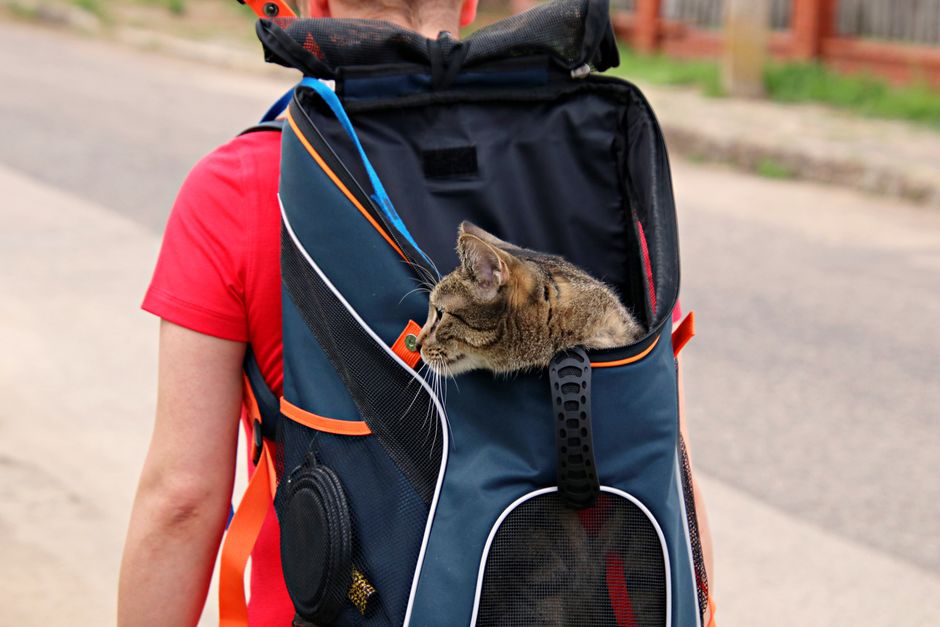
The question we get most often is whether a sling is tough enough for hiking. The honest answer is no. A sling is a weak fit for hiking. No change of cloth fixes that.
A trail asks for things a sling cannot give:
- A closed refuge when a dog or a coyote appears.
- A floor where the cat can sit and rest.
- Your hands and back free for an hour.
That is a structured backpack's job. If trail time is the goal, start with our best hands-free cat carrier roundup. It covers the backpack formats. Leave the sling for the walk around the block.
The car is the same answer for a different reason. A sling is not a restraint. A cat on your lap is a loose cat in a crash. The cat rides in a secured carrier. The sling is for the walk to it.
So the best cat carrier for walking depends on the walk. A structured backpack for the hour on the trail. A cat sling carrier for ten minutes down a quiet street. A calm cat on your chest, harness on, leash clipped.
Kept inside those lines, a cat sling for walking gives an indoor cat something a window cannot. The smell of the yard, from the safest place she knows. That is what the ComfyPaws sling does for ours. A few minutes at a time.

For the walk around the block
A sling for minutes, not miles.
For a calm cat that likes being held, on a walk of minutes. Breathable cotton, a strap that adjusts, and a clasp inside for the leash. Rated to 19.8 lb. Not for the trail, not for the car, not for a cat that hates being held.
See the ComfyPaws SlingQuestions this guide did not cover
Can I use a baby sling for my cat instead?
You can carry her in one, but there is nowhere to clip the leash. Cats.com describes a cat sling as a pouch much like a baby sling, with one difference: a safety strap, buckle or hook inside that attaches to the cat. A baby sling has none. So the leash ends in your hand. Fine on the sofa. Not for the street.
What if the sling is too big for my cat?
Size down. We Love Cats and Kittens warns that a sling that is too big "can easily swallow your cat and leave them completely smothered by the sling material." A buried cat cannot see out, and you cannot see her ears. The test: with the strap set for you, her head should clear the top edge when she sits.
Would a cat stroller work better than a sling?
For a cat that will not be held, a stroller is the other way outdoors. Two warnings first. Cats.com notes that some cats are scared by the vibration and sound of wheels, especially on rough ground. NBC Select says wheeled carriers are less stable than ones you hold. A stroller suits a cat that likes to watch. A sling suits a cat that wants to touch.
Can I use a sling to get a kitten used to the outdoors?
Yes. Catster says a sling is "especially great when you are trying to socialize kittens when they are young." She meets sounds, smells and people from a safe spot against you. Two limits: wait until her vet says her shots are done, and keep the harness-and-clip rule from day one. The routine is in kitten socialization with a sling.
Related reading
- Best Cat Sling Carrier 2026: Honest Guide
- Cat Sling for Cats That Hate Being Held: Does It Work?
- Wearable Cat Carriers Explained: Sling vs Papoose vs Front Pack vs Backpack
- Best Hands-Free Cat Carrier: Top Picks
About this article
Written by the PetzyMart Team. Sources include the AVMA, AAFP, International Cat Care and Fear Free, linked where each claim appears in the text. Reviewed and updated September 8, 2026. For medical decisions about your individual cat, always consult your veterinarian.