Wearable Cat Carriers Explained: Sling vs Papoose vs Front Pack vs Backpack
By the PetzyMart Team · Sources linked in the text · Last updated: September 8, 2026
Search for a wearable cat carrier. The first three results are three different things. One is a cloth pouch worn over one shoulder. One is a baby carrier with a cat in it. One is a backpack with a round window.
A wearable cat carrier is any carrier you wear instead of hold. There are three designs: the sling, the papoose or front pack, and the backpack. Each one solves a different problem:
- Sling: a short, calm carry.
- Papoose or front pack: an upright carry that holds the cat snug.
- Backpack: structure for long stretches.
This is not a ranked list. Want picks with names and specs? Our best hands-free cat carriers roundup already does that. This page compares the designs on the things that decide whether your cat puts up with one. How it loads. How the cat sits. How it stays closed. How long you can wear it. Heat, the car, cleaning, and which cats each one suits.
The Three Designs Defined
Stores use a dozen names for three shapes. Sort them first. It saves a return.
- Cat sling, cat body carrier, cat carrier on body: one wide strap, one shoulder. The cat lies half back.
- Cat papoose, cat papoose carrier, cat front carrier, cat front pack, cat chest carrier, cat carrier on chest, cat bjorn: two straps. The cat sits upright against your chest.
- Cat backpack, bubble backpack, space capsule: a closed pack on your back.
- Hands free cat carrier: the name that covers all three.
Find your product's name above, then read its section.

The Sling
A sling is one wide strap worn across the body. The pouch sits between your hip and your chest. The cat lies half back in the pouch, head out, body against yours. It is the way a cat lies in the crook of your arm.
Our own cat refuses any box. What works for her is a body-close cat sling carrier. She rides in it from the front door to the car. She rides in it again from the parking lot to the clinic door. In the sling she is quiet. In a carrier she is not, until the car moves and she has no choice.

The ComfyPaws sling is our example for this column. It is made of breathable cotton. The strap adjusts, so the pouch sits high and does not swing at the hip. It has a safety clasp for the harness. Its limits are the same as every sling's:
- Short calm carries only.
- The harness clips to the clasp every time.
- It comes off before the car moves.
- It is wrong for a cat that hates being held.
- Check the listed weight limit before you order.
Those five apply to every sling, not just ours. The full case for and against slings is in our best cat sling carrier guide.
The Papoose or Front Pack
A cat papoose borrows the baby-carrier shape. Two shoulder straps. A chest buckle. A pouch on your front that holds the cat upright, facing you or facing out. Owners call it a cat bjorn.
Two kinds sit under this name:
- Soft papoose: a cloth pouch that wraps the cat up to the neck. Head out, legs tucked in.
- Structured front pack: sometimes sold as a cat front carrier. It has a firmer shell. Many have four leg holes, so the cat's legs hang free like a toddler's.
What sets this design apart from a sling is posture. The cat is upright and belly to chest, not lying back. Does your cat accept being held upright against your shoulder? Then she will usually accept a papoose. Does she go stiff the moment her back leaves your arm? Then she will not.
The Backpack
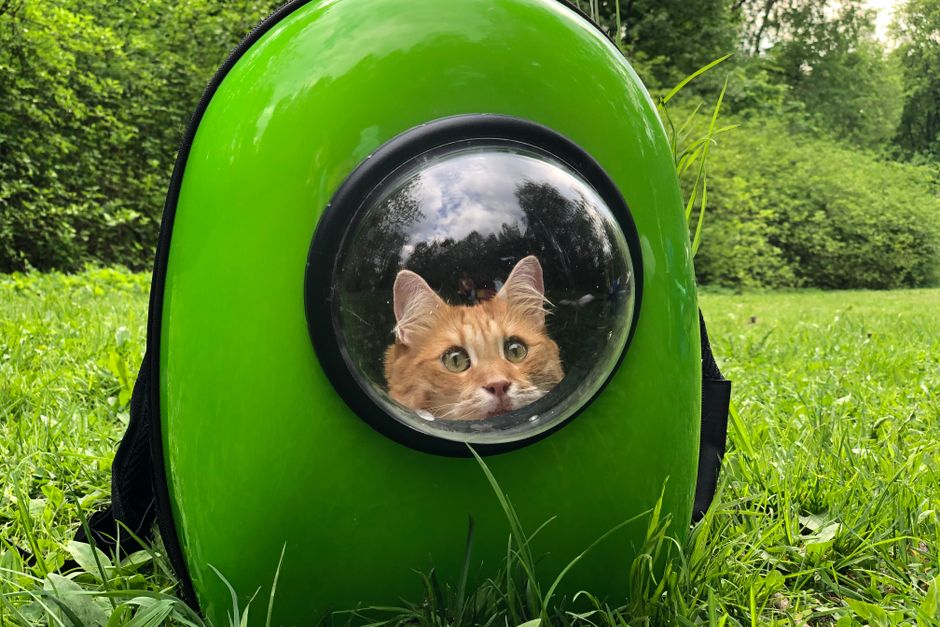
A backpack carrier is a closed box with a semi-rigid or rigid frame. It has a bubble window or a mesh panel, and padded straps. The cat sits or curls up inside. You carry the weight on your back. The cat sees out.
The popular packs list similar specs: several air vents, a tether inside that clips to the harness, self-locking zippers, and a weight limit that changes by model. Some can be worn on the front or the back.
It is the only design where a shell sits between the cat and your body. It is the only one with real structure. Those two facts decide most of what follows.
Four Formats Compared
The table draws on published specs, owner reviews across the major stores, and our own daily use of a sling. We have not tested other brands in a lab. We do not claim to.
| Dimension | Sling | Papoose (soft) | Front pack (structured) | Backpack |
|---|---|---|---|---|
| Loading | Lower cat in from above | Lift cat upright into pouch | Thread legs through holes | Load like a carrier, zip |
| Cat posture | Semi-reclined, head out | Upright, wrapped to neck | Upright, legs free | Seated or curled, enclosed |
| Security | Tether to harness only | Tether plus wrap | Tether plus buckles; legs can push | Zippers plus tether; enclosed |
| Duration | Minutes to a short walk | Short walk | Short walk | An hour or more with breaks |
| Weather | Two bodies of heat | Two bodies of heat | Two bodies of heat, legs exposed | Vents, but window traps sun |
| Car use | No | No | No | No, unless secured with the cat inside |
| Cleaning | Machine wash whole | Machine wash most | Wipe shell, wash liner | Remove pad, wipe shell |
| Suits | Box-phobic cat that likes being held | Cat that accepts upright hold | Wriggler that tolerates upright hold | Cat that accepts enclosure; trails, transit |
One pattern runs across the table. The closer the cat is to your body, the more the design needs the cat to go along with it. The more structure it has, the more it needs the cat to accept being closed in.
Dimension by Dimension
Loading and Posture
🤲 Sling: loads from above
Open the pouch. Lower the cat in. She settles into a half-back curl.
🫂 Papoose: loads upright
Lift under the front legs. Lower her in, chest to yours. A legs-out pack adds a step: each leg through a hole.
🎒 Backpack: loads like a carrier
Unzip, place, zip. The only ask is a small closed space.
Owners ask what a carrier needs to be comfortable. For wearables, the answer is posture first. A cat forced into a position she avoids in your arms will not settle in any cloth.
Security and Closures
Each design fails in its own way. Knowing the failure tells you what to check.
A sling without a tether is a scarf. The safety clasp is the security. The clasp goes to a harness, never to a collar. A collar slips over the head the moment a cat pushes backward. Clip it before you lift her, every time.
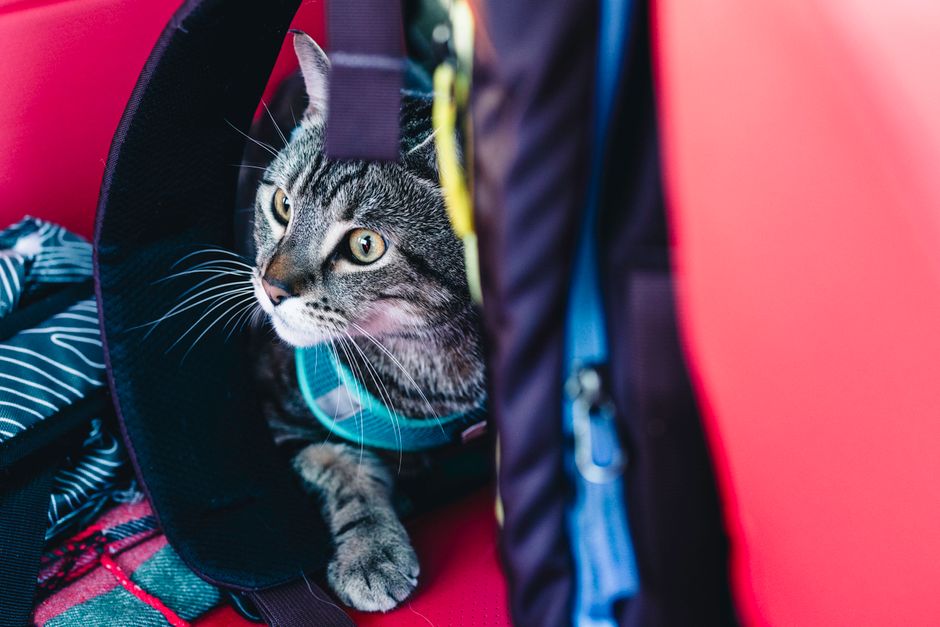
A papoose adds the wrap to the tether. A wrapped cat has less to push against. The legs-out front pack gives that back. Four free legs are four levers. A determined cat can push up and out of an open-top pouch.
A backpack has the most closure. Self-locking zippers, a tether inside, and a shell. A startled cat has nowhere to launch from. Its weak point is the zipper pull you forgot to lock.
One question comes up on every forum: can a cat use a regular baby carrier? No. A baby carrier is shaped for a human spine. It has no tether and no closure. A cat leaves it the instant something moves. International Cat Care puts the standard plainly: a carrier must be strong enough to prevent escape and easy to clean. A baby carrier is neither.
Duration and Weather
Every body-close design puts your body heat and the cat's together under cloth. On a mild day, that is the point. On a July sidewalk, it is a heat problem within half an hour. Cats overheat faster than people do.
Cotton and mesh panels breathe better than fleece or polyester. That is why we treat a sling or papoose as a tool for minutes to a short walk. Nothing longer, in any weather.

A backpack has vents and an air gap. So it is the only design built for an hour or more. Its weak spot is the bubble window. It acts like a greenhouse in direct sun. Owners of bubble packs tend to keep the window shaded. Or they swap it for the mesh panel in summer.
Watch the cat, not the clock. Fear Free's cat body language guide lists the stress signs that mean stop:
⚠️ Stress signs that mean stop (Fear Free)
- Open-mouth panting
- Ears pinned back
- A stiff body
- A low growl or a fixed stare
For long hikes, the honest answer is a backpack with a tether. Add breaks out of it. Add water. No sling or papoose is built for that distance.
Car Use
None of the four is a car-safety device. Not the sling. Not the papoose. Not the front pack. Not a backpack sitting on a seat.
AVMA policy is that pets travel in a secured carrier or restraint while the vehicle is moving. The AAFP position statement on transporting cats says the same: an appropriate carrier, secured in the vehicle.
A cat on your chest in a moving car is a loose cat with a strap. We wear the sling to the car door. Then we move our cat into a carrier belted on the back seat. We answer the full question in is a cat sling safe in the car.
A backpack is the one design that can double as the car carrier. But only if it is belted in with the cat inside and the straps put away. On your lap, it is as loose as a sling.
Cleaning
A cotton sling is one piece of cloth. So it goes in the machine whole. That matters, because a stressed cat may pee. iCatCare's easy-to-clean rule exists for that reason.
A soft papoose usually washes the same way. A structured front pack has a shell that wipes clean, and a liner. The liner may or may not come out. Check before you buy.
A backpack has a pad you take out and a shell you wipe. Bubble windows scratch. Mesh panels hold hair. Budget for a lint roller.
Which Cats Each Suits
A sling suits the cat that fights the box but relaxes in your arms. She weighs less than the listed limit. She only needs carrying for minutes. If your cat hates being held, a sling is wrong. Our piece on a cat sling for cats that hate being held is honest about that.
Listed weight limits, by design
From published product specs.
Weigh your cat before you order. A 14 lb cat is over most sling limits, inside ours (19.8 lb / 9 kg), and inside every backpack limit.
A papoose or front pack suits the wriggler. That is the cat that squirms out of a loose hold, but calms when strapped upright and snug against your chest. Many cats that ride well in a legs-out pack are young, light, and confident.
A backpack suits the cat that accepts a small closed space. It also suits the owner who needs time: a trail, a train, a long walk. It is the only wearable some cats treat like a den.
Are wearable carriers suitable for all cats? No. Some cats dislike handling and enclosure alike. That cat is best served by a normal carrier she has been trained to enter. No strap will change that.
Which One for Your Cat
Match the cat first and the trip second.
Match the cat first, the trip second
SlingShe lies the way she already likes to be held. The tether does the rest.
Papoose or front packThe wrap gives the security the sling cannot.
BackpackAirflow, structure, and the time budget.
Two more cases:
- Dislikes being held at all: none of the three. Go back to a top-loading carrier and train it. Read the cat-that-hates-being-held article above before spending anything.
- Summer, long outdoor time, a heavy cat: a backpack with the mesh panel, or stay home until evening. Body-close designs and heat do not mix.
Find your cat on these lists. Then buy for that line only.
For the first case, the ComfyPaws sling is our pick. It comes with the same five limits we listed in the sling section. Read them again before you order.

For the cat that fights the box
The sling column, in real life
For the cat that fights the box but settles in your arms. Soft cotton, a mesh panel for air, a strap that adjusts, and a safety clasp for her harness. It covers the walk to the car and into the clinic. Not for the drive, and not for a cat that hates being held. Check the listed weight limit first.
See the ComfyPaws SlingThe Honest Limits
Every wearable trades something away. Here is the bill for each.
🤲 Sling
No structure, so a determined cat can climb out. A weight limit that rules out many adult males. No car use. Two bodies of heat.
🫂 Papoose or front pack
Demands an upright posture many cats refuse. Legs-out versions give the cat something to push against. The same heat problem. Harder to clean when structured.
🎒 Backpack
The heaviest to wear and the bulkiest to store. The cat is closed in, which some cats never accept. The bubble window makes a cat that is upset by a wide view worse, not calmer.
Read the bill for the design you want before you pay for it. None of them makes a scared cat calm. None holds a cat that has decided to leave. None replaces the carrier you belt into the car. A wearable is a tool for one moment. And the moment is short.
A Note on Kittens
Searches for a kitten chest carrier come from owners doing the right thing. They want a young cat used to the world early. A light, curious kitten is the easiest passenger any of these designs will ever carry. That is why a sling or soft papoose works well for short outings to see the world. We cover the how in kitten socialization in a sling.
Two cautions:
- A kitten fits through gaps an adult cannot. So the tether clips to a kitten-sized harness, and the pouch stays snug.
- Until her vaccination course is complete, keep her off public ground. Keep her away from unknown animals too. The carry is for looking, not for exploring.
Pick the wearable cat carrier that matches how your cat already likes to be held. Not the one with the best photo. For the cat that refuses the box and rides quietly in an arm, a cat sling carrier covers the walk to the car. The carrier covers the drive.
Questions this guide did not cover
Do cat charities recommend wearable carriers at all?
One large one says no. Cats Protection writes that backpack-style carriers "might look convenient, but we don't recommend them." Most are too small to stand or turn in, and the up-and-down motion of walking can feel unstable. It calls a sturdy handheld carrier the safer choice, and says cats should not be carried around for long periods unless it is for their health. That is why this guide keeps every wearable to short trips.
Can a cat backpack go on a plane?
Some can. Catster's backpack roundup names the Pet Gear I-GO Plus Traveler as an airline-approved design. But "airline-approved" on a listing is not a promise. Each airline sets its own under-seat size and pet fee. Check the airline's pet page against the pack's measurements before you book.
Can I make a wearable cat carrier myself?
Yes, for short home-to-car use. Catster lists five DIY sling plans, from a fleece sling to a no-sew scarf wrap. Its safety line: a sling is safe "if it's well-constructed and can hold your cat's weight." A homemade sling has no clasp, so add a tether to the harness yourself.
How do I get my cat used to a wearable before the first trip?
Slowly, at home, over days. Cats Protection's carrier steps work for a backpack too: bedding near it, then closer each day, then inside it. Keep it out between sessions. Once she sits in it, close it and lift it so she learns the feel of being carried. This five-step backpack training video shows one owner's routine.
Related reading
- Best Hands Free Cat Carrier: 10 Top Picks for Travel 2026
- Best Cat Sling Carrier 2026: Honest Guide
- Cat Sling for Cats That Hate Being Held: Does It Actually Work?
- Is a Cat Sling Safe in the Car? Honest Answer
About this article
Written by the PetzyMart Team. Sources include the AVMA, AAFP, International Cat Care and Fear Free, linked where each claim appears in the text. Reviewed and updated September 8, 2026. For medical decisions about your individual cat, always consult your veterinarian.