Best Breathable Cat Carrier for Warm Weather
By the PetzyMart Team · Sources linked in the text · Last updated: September 19, 2026
You are ten minutes from the clinic. The air is on. But your cat has her mouth open, and there are damp marks on the floor of the bag.
A breathable cat carrier is easy to spot. Mesh on three or four walls. Some of that mesh up near the roof. And feet or rims, so no wall can sit flat against a car seat.
Almost every "breathable" label is about the cloth. The cloth is not what heats her up. What matters is how much of the box is open, and whether that opening is blocked.
Here is what this guide covers:
- Why heat reaches a cat faster than it reaches you
- Why listings count panels, and what the rule measures
- A five minute test you can do in the shop
- Soft, backpack or hard sided, for the trip you take
- What too hot looks like from the outside
Why Heat Reaches Cats First
A carrier is a small box inside a bigger box. The car warms up. Then the bag warms up after it, and stays warm longer, because the cat inside is a heater that never turns off.
Cats cool off in small ways. They groom, they hunt for a cool floor, and their paws go damp. None of that helps much inside a zipped bag.
PetMD is blunt about this: unlike dogs, cats do not typically pant to cool themselves. So an open mouth in a cat is a sign to act on, not a fan doing its job. PetMD puts heatstroke at a body heat past 104 degrees.
Some cats reach that line sooner:
- Flat faced cats, like Persians. The ASPCA says they cannot pant as well.
- Heavy cats and old cats.
- Kittens four months old or younger.
- Cats with heart, lung or kidney trouble.
If your cat is on that list, buy for air first. Buy for looks later.
Damp days count as well. In its list of when cats get heatstroke, PetMD names very humid days right beside very hot ones. So a mild, sticky morning is still a morning to check her.
What the Mesh Rule Says
Carrier listings sell air by counting. Mesh windows. Open doors. Sides with vents.
A count is not a measurement. One wide panel can beat a row of small ones, and a count of panels does not tell you their size.
There is one place in this market where air is measured instead of counted. It is a federal rule for pets shipped as cargo. It does not cover the bag under your seat. It is still worth two minutes.
The last one is the one people skip. A vent with a car seat pressed against it is not a vent.
So the useful test is not what the label claims. It is what you can count with a tape measure. Measure one wall, then measure the mesh panel on it. Divide the second by the first. Do the same on the next wall. Two minutes, and you know more than the box does.
None of this binds the bag under an airline seat. There the size limit comes first, and the mesh has to fit inside it. Ask the airline for the seat measurement, then buy the most open bag that fits, not the biggest one.
Test a Carrier in Five Minutes
Do this on the shop floor, before your cat ever sees the thing.
-
1
Count the open walls
Three or four. Two is a floor, not a goal.
-
2
Look up
Some mesh belongs near the roof. Warm air collects there, not down where she sits.
-
3
Turn it over
Look for feet, or a hard lip that keeps the mesh off the seat.
Why: a panel flat on upholstery moves no air.
-
4
Push a wall in with your thumb
If it folds flat, a scared cat can shut it with her shoulder.
-
5
Carry it the way you will carry it
On your hip, or belted in. Then see which panels went flat.
Buy the one that passes step five. That is the step the store display cannot show you.
Soft, Backpack or Hard Sided
No type wins on air alone. Pick for the trip, and for the cat you own.
🧳 Soft sided
Most mesh for the money. But the walls fold, so a scared cat can press one shut.
🎒 Backpack
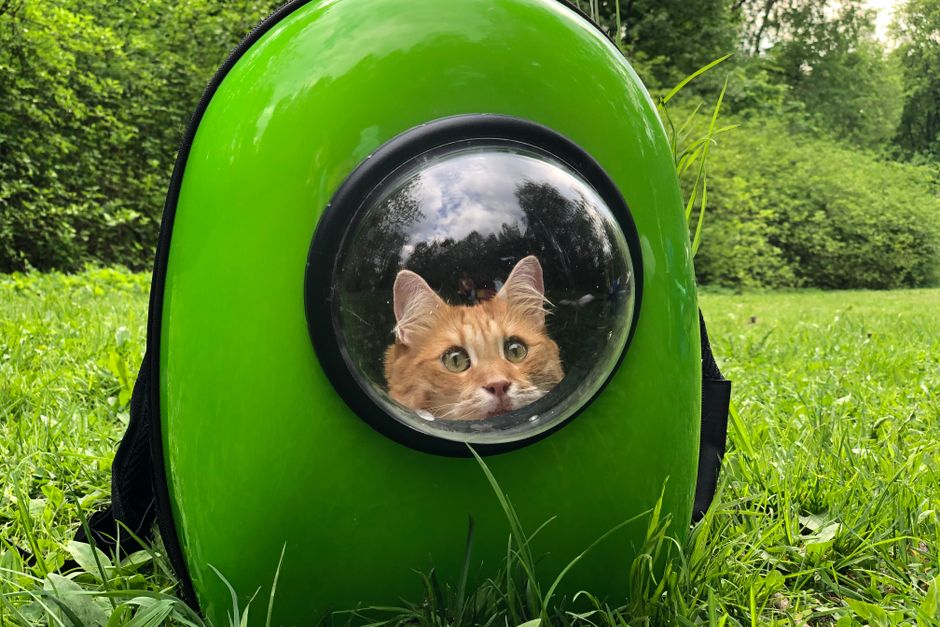
Rides high, off hot pavement. Many use a clear plastic bubble instead of mesh. A bubble is a window, not a vent.
📦 Hard sided
Moulded slits, so the open share is small and fixed. It does wipe clean. International Cat Care wants a carrier that is easy to clean, and rates top opening ones much easier to use.
Want the long version of that trade? We wrote it up in soft sided versus hard cat carriers. For packs and slings, see hands free carriers.
Cover the Sides, Not the Vents
A scared cat wants dark. Dark usually means a cloth thrown over the box. That cloth lands on the mesh.
Both things can be true at once. Cover the sides she stares out of. Leave the vented door end open to the room.
International Cat Care says to cover the carrier with a cloth or towel while you travel, and to belt it down on a seat or in the footwell. On a warm day, pick the thinnest cloth in the house. Fleece is a blanket. A cotton sheet is a curtain.
The whole method is in should you cover a cat carrier with a blanket.
The 85 Degree Line
There is a second number worth knowing. This one is about the air around the carrier, not the carrier itself.
The same federal standards set a heat line for animals in transit, and 85 degrees is where it sits.
Those limits bind the people who move pets for a living. Your car is not covered by them. Your cat is. At that line the law makes a shipper act. Nobody makes you.
So run the air before she goes in the car, not after. And park in shade even for the short stop, because the mesh only works if the air outside it is cooler than she is.
What Too Hot Looks Like
PetMD keeps two lists here, not one. Heat exhaustion comes first. Heatstroke is the emergency.
⚠️ Check her at every stop. Look for:
- Mouth open, breathing fast
- Drooling, or a wet chin
- Damp paw prints on the carrier floor
- Pressed flat to the coolest wall instead of curled up
If she is already too hot, the Cornell Feline Health Center says to move her somewhere cool with a draft, wet her fur with cool water, and call your vet. Cool, they write, not very cold. PetMD adds a damp towel on her back, and cool water on her ears and paw pads.
What a Sling Does, and What It Does Not
We carry our own cat in a sling for the short legs. Front door to car. Parking lot to clinic desk.
The ComfyPaws sling we use has a cotton outer and a honeycomb mesh lining. Read that carefully. The mesh sits behind the cloth, so it is a lining, not an opening. By this guide's own test the bag has no open walls at all. The air she gets comes from her head and shoulders being outside it.
For the cat who fights the box at the door, that swap is the whole battle.

Now the honest half.
A sling is not a car seat. It has no crash protection. Once the car moves, she goes in a belted carrier.
A sling does not stop a cat overheating. Your chest is warm. On a hot day you are one more layer, so a sling is for minutes, not for a drive.
And it is no good at all for a cat who hates being held. That cat needs a top opening box and a shorter trip, not a closer one. Our full comparison lives in the cat sling carrier guide.

The sling in the photo above
The sling, by the numbers
Rated to 19.8 lb. The strap adjusts 9.8 inches, so it fits wearers from 4 foot 11 to 6 foot 3. The safety clip goes on a harness, never a collar. 12.3 oz, and it goes in the wash.
See the ComfyPaws SlingBottom Line
Three or four open walls. Some mesh up high. Nothing pressed flat against a panel.
The best breathable cat carrier is the one that passes those three checks in your hands, not the one with the best label.
Then the part no carrier can do for you. Run the air first. Keep the cloth thin. Look at her at every stop.
No bag makes a hot car safe. It only buys you the minutes between the door and the vent. If you are still choosing, our cat carrier buying guide covers the rest of the checklist.
Questions this guide did not cover
Can I put a cooling mat or an ice pack in the carrier?
A mat, yes. Loose ice, no. The Cornell Feline Health Center lists cooling mats among its hot weather steps, and wraps ice packs in blankets first. Never dry ice: 9 CFR 3.16(h) bars shipping it with cats in any way that could harm them.
Does she need water in there on a long drive?
The schedule you will find quoted is a shipping rule, not travel advice. 9 CFR 3.17 binds licensed shippers: water at least once every twelve hours, food at least once every twenty four for a cat sixteen weeks or older, and every twelve hours for a kitten younger than that. All of it offered within four hours of setting off. That is a floor for cargo, not a plan for your car. Offer her water before you leave, and ask your vet what she needs on the road.
Should I trim or shave a long haired cat before a summer trip?
A trim is fine. A shave is not. The ASPCA says it is OK to give a long haired cat a summer cut, but never to shave down to the skin, and to leave the cutting to a professional groomer. Its reason: the coat's layers are part of the cooling system, and stripping them risks overheating, sunburn and skin cancer. Its hot weather page adds one line for cats: brush more often than usual.
She pants in the car even with the air on. Heat or fear?
Often fear, and it still needs watching. PetMD lists stress, such as a car ride or a vet visit, among the everyday reasons a cat pants, alongside heat and pain. With an obvious trigger it says to let her settle, and to call the vet if it does not stop. So the checklist above still stands. Let her settle first. If the panting does not stop, or a second sign shows up, treat it as heat and cool her. Pale, blue or yellow gums, gagging or collapse means the emergency vet.
Related reading
- Soft-Sided vs Hard Cat Carrier: How to Choose
- Should You Cover a Cat Carrier With a Blanket?
- Cat Carrier Size Guide: How to Measure Your Cat
- Best Cat Carrier for Travel: What to Look for Before You Buy
About this article
Written by the PetzyMart Team. Sources include PetMD, the ASPCA, ecfr.gov, International Cat Care and the Cornell Feline Health Center, linked where each claim appears in the text. Reviewed and updated September 19, 2026. For medical decisions about your individual cat, always consult your veterinarian.